
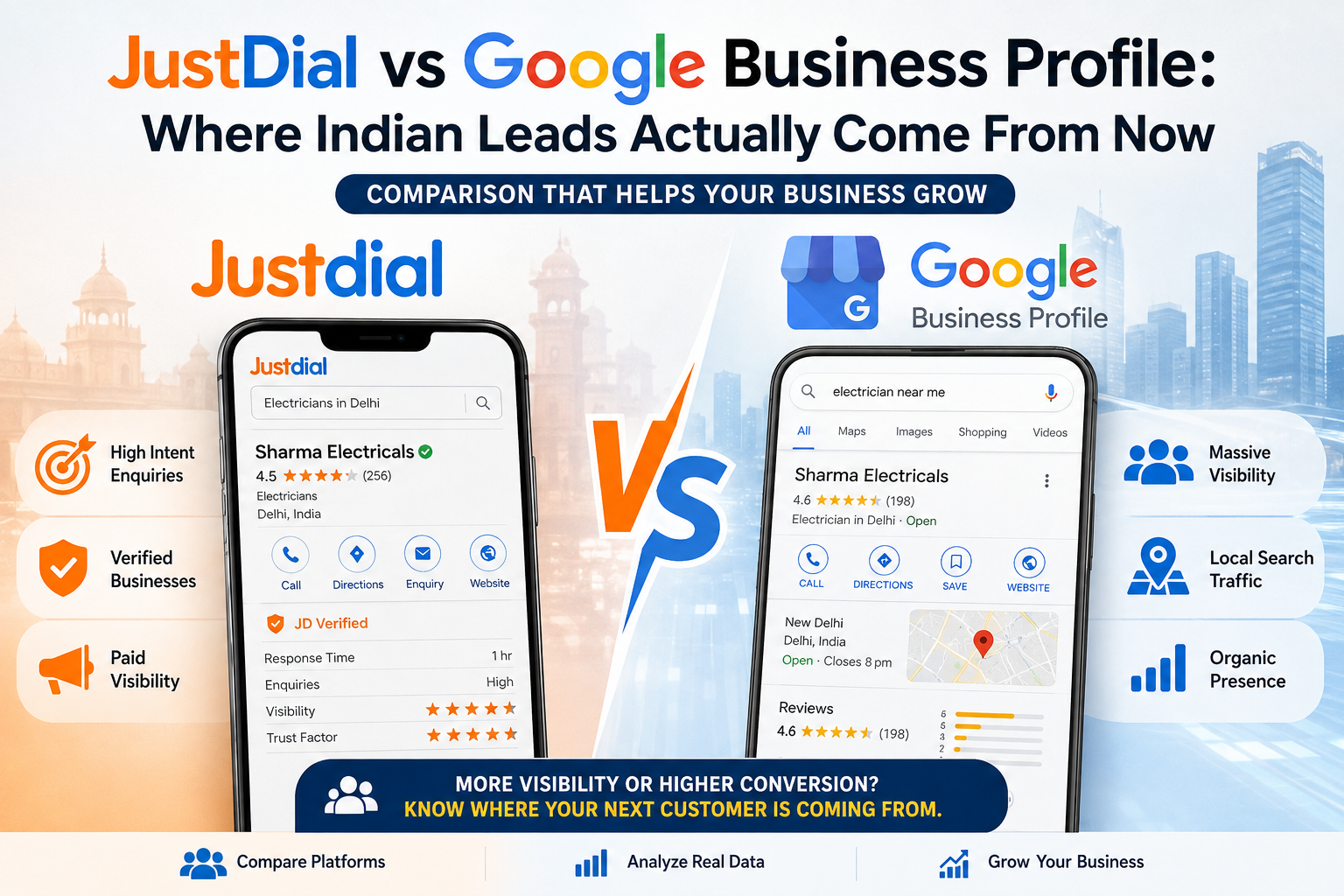
Every few weeks a JustDial executive calls a business owner in Delhi and offers a package. ₹36,000 a year. ₹84,000 for premium. Guaranteed visibility, guaranteed enquiries. The owner has heard the pitch before, maybe paid for it before, and has no real way to judge whether it’s worth it.
Here’s a way to judge it. In the quarter ending March 2026, JustDial’s active listings grew 12.1% year on year to 54.7 million. Over the same period, its traffic fell 4.7% to 182.4 million unique visitors. Both figures come from the company’s own results filing.
Read those two numbers together. More businesses are competing on the platform every quarter, and fewer people are visiting it. That’s not an opinion about JustDial’s quality. It’s arithmetic about your odds.
This article compares JustDial and Google Business Profile honestly — including the cases where JustDial is still the better buy, because they exist and most agency blogs pretend they don’t. Then it gives you a way to measure which one actually works for your business rather than trusting either sales pitch, ours included.
What JustDial’s own numbers say
JustDial is listed, so it discloses operational metrics every quarter. That makes this the rare comparison you can run on audited figures rather than vendor claims.
From the FY26 results:
| Metric (quarter ending 31 March 2026) | Figure | Change YoY |
|---|---|---|
| Unique visitors | 182.4 million | −4.7% |
| Active listings | 54.7 million | +12.1% |
| Active paid campaigns | 631,530 | — |
| Revenue from operations | ₹307.2 crore | +6.2% |
| Operating EBITDA margin | 28.9% | — |
Three things worth pulling out.
Traffic per listing is falling fast. Divide visitors by listings and the ratio dropped roughly 15% in a single year. Every quarter, the same audience is split across more businesses. If you renewed at the same price this year, you bought less.
Traffic is also falling sequentially. It was 197.7 million in the September 2025 quarter and 182.4 million by March 2026. That’s a trend, not a seasonal dip.
Only about 1.2% of listings are paid campaigns. 631,530 paying advertisers out of 54.7 million listings. Whatever the sales call implies, being listed is not the same as being found — the platform is built so that free listings mostly exist to make the paid tier necessary.
One honest correction to something you may read elsewhere: JustDial’s net profit fell 36.5% in that quarter, and several articles have used that as proof the business is collapsing. It isn’t quite that. The profit drop was driven largely by lower treasury income as bond yields moved, not by the core operation, which still grew revenue 6.2% at a healthy margin. JustDial is a profitable company. The problem for you as an advertiser isn’t its profitability — it’s the traffic-per-listing ratio, which is a different thing entirely.
What you’re actually buying, on each platform
The financials matter less than the structural difference, which most comparisons skip.
| JustDial | Google Business Profile | |
|---|---|---|
| Cost | ₹30,000–₹1,00,000+ per year, negotiated | Free |
| What you own | Nothing. Placement is rented and ends when you stop paying | An asset tied to your business, with reviews and photos that persist |
| How you rank | Largely by package tier | By relevance, distance and prominence — earned, not bought |
| Lead exclusivity | The same enquiry typically goes to several listed businesses at once | The customer calls or messages you directly |
| When you stop paying | Visibility drops immediately | Nothing changes; the profile stays |
| Renewal pressure | High — roughly 12,000 telesales and field staff across 250+ cities | None |
| Reach concentration | About 70% of revenue from the top 11 cities | Wherever your customers are |
The exclusivity line is the one that decides most cases. On JustDial’s core model, an enquiry is distributed to multiple advertisers in the category, and you compete on speed and price with three or four others who received the same lead. On Google, someone searching “AC repair near me” sees the map pack, taps your listing, and calls you. Not you and four competitors. You.
That difference explains why lead-quality complaints are common in public reviews of JustDial’s paid packages, sitting alongside genuinely positive ones from long-term advertisers. Both sets of reviews are describing the same mechanism accurately. A shared-lead model works well when demand is urgent and abundant, and works badly when it isn’t.
The search behaviour that changed underneath both platforms
JustDial’s original product was a phone number. You called 88888-88888 and a human told you where to buy a washing machine. That was genuinely useful in 2005, when most Indians had no smartphone.
Today, 85.7% of JustDial’s own traffic comes from mobile and only 2.8% from its voice platform. The behaviour it was built for has largely moved to a search box and a map.
Meanwhile, the discovery moment has consolidated. When someone in Lajpat Nagar wants a dentist, the sequence is: unlock phone, type “dentist near me”, look at the three map results, check the star rating, tap call. Your Google Business Profile is the entire storefront in that moment — the rating, the photos, the hours, whether the phone number works.
There’s now a third layer forming on top. When someone asks ChatGPT or Gemini for a recommendation, the assistant is pulling from structured, well-maintained public sources — Google’s local data prominently among them. A neglected profile isn’t just invisible in the map pack now; it’s invisible to the tools an increasing number of people ask first. That’s a reason to fix the free asset before renewing the paid one.
Where JustDial still genuinely works
This section exists because a comparison that concludes “the free thing is always better” isn’t a comparison, it’s marketing. JustDial still earns its fee in specific situations.
Urgent, commoditised, phone-first services. AC repair, packers and movers, pest control, plumbing, appliance servicing. The customer wants three quotes in ten minutes and doesn’t care who you are. Shared leads suit that. If you can quote fast and close on the phone, volume compensates for exclusivity.
Tier-2 and tier-3 cities with older buyers. JustDial’s voice platform is a small share of traffic overall, but it’s not evenly distributed. In markets where a 55-year-old buyer would rather call a number than navigate an app, that channel still converts.
B2B industrial supply via JD Mart. If you sell fasteners, packaging material or machine parts, JD Mart reaches procurement buyers who genuinely use it, and Google’s map pack is a poor fit for a category where nobody searches “near me.”
Businesses with no website and no capacity to build one. A paid JustDial listing gives you a landing page, a phone number and a payment method without hiring anybody. That’s a real service, even at the price.
If you’re in one of those four situations, don’t cancel on the strength of a blog post. Measure it, using the method below.
Where it stops making sense
Considered, high-ticket purchases. Interior design, cosmetic dentistry, real estate, hair transplants, education. These buyers research for weeks and choose on trust. They read reviews, look at photos, check the website. A directory listing does almost none of that work.
Anything where you want to own the relationship. Every rupee spent on JustDial buys visibility that ends the day you stop paying. Every hour spent on your Google profile, reviews and site builds an asset that keeps working.
When the maths doesn’t clear. This is the actual test. Take your annual package cost, divide by the number of customers — not leads, customers — you can attribute to it. If your ₹36,000 package produced eleven paying customers, you paid ₹3,270 to acquire each one. Is that better or worse than your other channels? Most business owners renewing a package have never run this calculation, which is precisely why the renewal call works.
The 90-day plan
If you do nothing else from this article, do this in order.
Days 1–7: claim and complete the free asset. Verify your Google Business Profile. Fill in every field — categories, hours, service area, attributes, description. Add at least ten real photos of the actual premises, staff and work. Add products or services with prices where relevant. A complete profile outperforms an incomplete one by a wide margin, and this costs nothing but an afternoon.
Days 8–30: build the review engine. Ask every satisfied customer, in person, the day the job is done. Send a short link over WhatsApp. Reply to every review, including the bad ones, in a measured tone. Reviews are the single biggest lever most Indian businesses have and the one they neglect hardest.
Days 8–30, in parallel: start measuring. Details below.
Days 31–90: post weekly and watch the data. Use Google Business Profile updates for offers and new work. Check the performance tab monthly: calls, direction requests, website clicks, and which search terms surfaced you.
Day 90: decide on JustDial with evidence. By now you’ll know what the free channel produces and what the paid one produces, and the renewal conversation stops being a negotiation about feelings.
How to actually tell which channel is working
Almost nobody does this, and it’s why the argument never resolves.
Use a separate phone number for each channel. The cheapest version is a second SIM listed only on JustDial. Anything that rings it came from there. Full call tracking is better, but a second SIM costs ₹200 a month and settles the question.
Ask every caller how they found you. One line, recorded in a notebook or a Google Sheet. Do it for sixty days and you’ll have better attribution data than most companies with a CRM.
Tag your links. Any URL you give JustDial should carry a UTM parameter so the visits show up separately in your analytics.
Count customers, not enquiries. JustDial’s dashboard reports leads delivered. Leads delivered is not a business outcome. Track how many became paying customers and what they were worth.
The short version, by business type
| Your business | Where to put the effort |
|---|---|
| Restaurant, salon, gym, clinic, retail store | Google Business Profile, decisively. Reviews and photos are the whole game |
| AC repair, movers, pest control, plumbing | Both. GBP first, and keep JustDial if the per-customer maths clears |
| Real estate, interiors, cosmetic and dental, education | GBP plus paid search. Directory listings do little for considered purchases |
| Industrial and B2B supply | JD Mart has a genuine role. Add GBP anyway — it’s free |
| Any business without a website | GBP first, because it’s free and it’s yours, then build the site |
Frequently asked questions
Is JustDial still worth it in 2026?
It depends on your category. JustDial’s own filings show traffic down 4.7% year on year while listings rose 12.1%, meaning more advertisers are sharing a smaller audience. It can still work for urgent, commoditised phone-led services and for B2B industrial supply. For considered, high-value purchases, the return is usually poor. Measure your cost per acquired customer before renewing.
Is Google Business Profile free?
Yes. Claiming, verifying and maintaining a profile costs nothing. Google does not charge for map pack placement and does not sell it — anyone offering to buy you a position is misrepresenting how it works.
Which gives better quality leads, JustDial or Google?
Google leads are generally higher intent, because the customer chose your listing specifically and contacted you directly. JustDial enquiries are typically shared with several advertisers in the same category, so you’re competing on response speed and price from the first second.
Should I cancel my JustDial subscription?
Not on principle — on evidence. Run a separate phone number for sixty days, count customers rather than leads, and calculate cost per acquired customer. Then compare that to your other channels and decide.
Can I use both?
Yes, and many businesses should. Google Business Profile costs nothing and should be running regardless. Treat JustDial as a paid channel that has to justify its cost like any other.
The uncomfortable conclusion
The free channel is the one most Indian businesses neglect, and the paid channel is the one they renew without measuring. That’s backwards, and it’s been backwards for about five years.
Namo Marketing has run local SEO for businesses across Delhi NCR for over three years — map pack rankings, review systems, and the tracking that tells you which channel actually paid for itself. If you’d like an honest read on where your leads are coming from before your next renewal call, book a free audit or call +91 9717 710 650.
Figures cited are from Just Dial Limited’s published quarterly results for the period ending 31 March 2026. This article reflects our assessment of the platforms as marketing channels and is not investment advice.
1 thought on “JustDial vs Google Business Profile: Where Indian Leads Actually Come From Now”