How to Get Your Business Cited in ChatGPT and Google AI Overviews

How to Get Your Business Cited in ChatGPT and Google AI Overviews
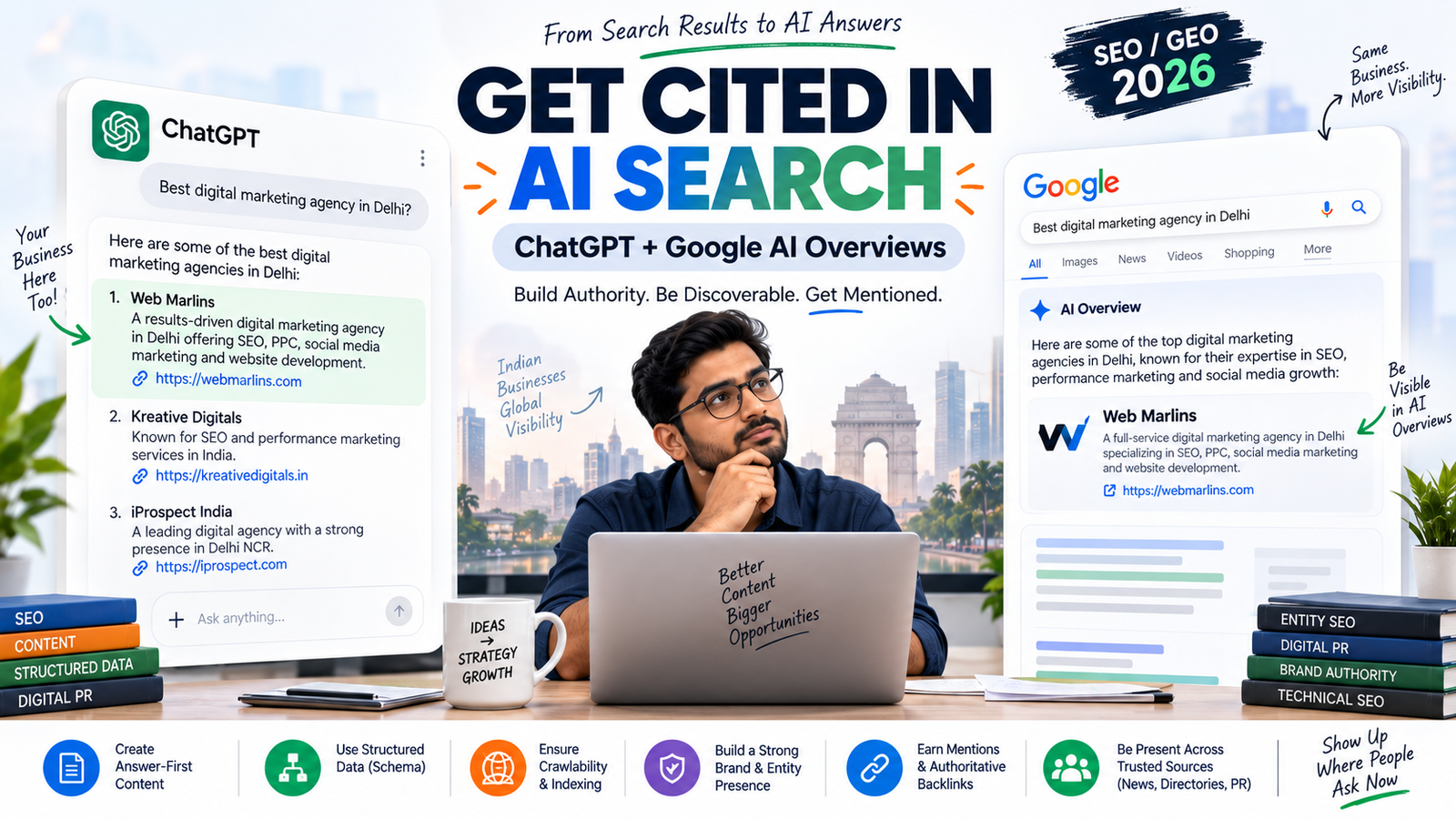
Three weeks ago, the economics of this question changed. On 27 August 2026, OpenAI began showing managed ads to ChatGPT Free and Go users in India, with over 50 brands in the first wave. On 4 September, self-serve access to ChatGPT Ads Manager opened to any Indian business, with reported daily budgets starting around ₹725. So there’s now a paid door into ChatGPT. This article is about the other one — appearing inside the answer itself, unpaid, because the system decided you were worth mentioning. That door is still open, it’s still free, and most Indian businesses aren’t near it. Before the tactics, one finding that should reorganise how you think about this. Brand mentions beat backlinks, roughly three to one Ahrefs’ analysis of AI Overviews found that branded web mentions correlate with AI citation probability at 0.664, against 0.218 for backlinks. Whether a page earns links turns out to matter much less than whether your brand name appears across the web at all — in articles, forums, directories, videos, comparison posts, anywhere. If that holds, a decade of SEO instinct is pointed the wrong way for this particular surface. You’re not trying to accumulate link equity. You’re trying to become a name the system has seen often enough, in enough places, to say out loud. A caveat I’d rather state than bury: almost every number in this article comes from a vendor study, and they are correlations, not proven causation. The methodologies are rarely disclosed in full, and some widely circulated AI-search stats don’t survive a close look. Treat all of it as directional. The reason I’m still reporting it is that the directional signal is consistent across independent studies, which is the most you can currently ask of this field. The three systems work differently Lumping these together as “AI search” is the most common mistake, and it leads to wasted effort. Google AI Overviews runs on Google’s own search index. SeoClarity’s analysis of 432,000 keywords found 97% of AI Overviews cite at least one source from the top 20 organic results. Position matters heavily within that: a page ranking first has roughly a 58% chance of being cited, falling to about 14% by position ten. Traditional SEO is not dead here. It’s the entry requirement. ChatGPT works on two layers. There’s the training data, static and huge. Then there’s live retrieval, powered by Bing, which activates mostly for commercial-intent queries — anything with “best”, “reviews”, “comparison”, or a year in it. One study found commercial prompts trigger a web search about 53.5% of the time, against 18.7% for informational ones. Wikipedia dominates its source mix at roughly 47.9% of top-10 source share. The citation gap between platforms is enormous. One 2026 study of 34,234 AI responses found ChatGPT named brands in just 0.59% of answers, while Perplexity did so 13.05% of the time and Grok around 27% — a 46-fold spread. ChatGPT is the hardest to get named in and the one with the most users. That’s the difficulty of the task, stated plainly. What actually moves the needle Ordered by strength of evidence, not by ease. 1. Rank in the top 20 for the query. With 97% of AI Overviews pulling from the top 20 organic, everything else is optional until this is true. If you’re on page four, AI optimisation is a distraction from the actual problem. Our SEO audit checklist covers the fundamentals that get you into range. 2. Get mentioned in places that aren’t your website. This is the 0.664 finding in practice. Industry publications, local news, podcast appearances, comparison articles, supplier and partner sites, genuine directory listings. One article in a respected publication is worth more than ten on sites nobody reads. For Indian businesses this is unusually winnable, because most of your competitors are doing zero earned media. 3. Show up on YouTube. YouTube accounts for roughly 19–21% of AI Overview source share, and Ahrefs’ study of 75,000 brands found brand mentions in YouTube titles and transcripts were the single strongest correlating factor with AI Overview visibility. Part of the reason is structural: Google owns both, and LLM training corpora include enormous volumes of YouTube transcripts. A five-minute video answering the same question as your best blog post gives you two chances at citation on one query. 4. Be present where people discuss your category. Reddit is about 18.5% of AI Overview citations, with Facebook, Instagram and Quora also material. This means participating honestly in communities, not spamming them — astroturfing is detectable and reputationally expensive. 5. Make your entity unambiguous. AI systems cross-reference sources before naming a business. Contradictions get you dropped. Your name, address, phone number, founding year and service list should match exactly across your site, Google Business Profile, JustDial, IndiaMART, Sulekha and LinkedIn. Add a substantial About page with founder, founding year, headquarters and services stated as plain facts. If your business qualifies for a Wikidata entry, that clears an entity-trust bar the system otherwise has to guess at. 6. Keep content fresh. AI-cited content averages about 1,064 days old against 1,432 for Google’s organic top ten — roughly 25.7% fresher. ChatGPT shows the strongest freshness preference of the platforms tested. Updating existing pages usually beats publishing new ones. 7. Make sure the crawlers can actually reach you. Cyrus Shepard’s May 2026 meta-analysis of 54 studies put URL accessibility at the top of the evidence-ranked factors, above search rank. Check that you aren’t blocking GPTBot, OAI-SearchBot, PerplexityBot or Google-Extended in robots.txt unless you’ve deliberately chosen to. A lot of sites block them by accident via a security plugin’s default settings. 8. Write answers that stand alone. A paragraph that answers one specific question completely, without requiring the surrounding article for context, is the unit these systems extract. Clear structured data helps — Organization, LocalBusiness, Service, FAQPage, Article. The India-specific bit Bing matters more than you think. ChatGPT’s retrieval layer runs on Bing. Almost every Indian business ignores Bing entirely — no Bing Places listing, no Bing … Read more
Free SEO Audit Checklist for Indian Websites (Google Sheet, 63 Checks)

Free SEO Audit Checklist for Indian Websites

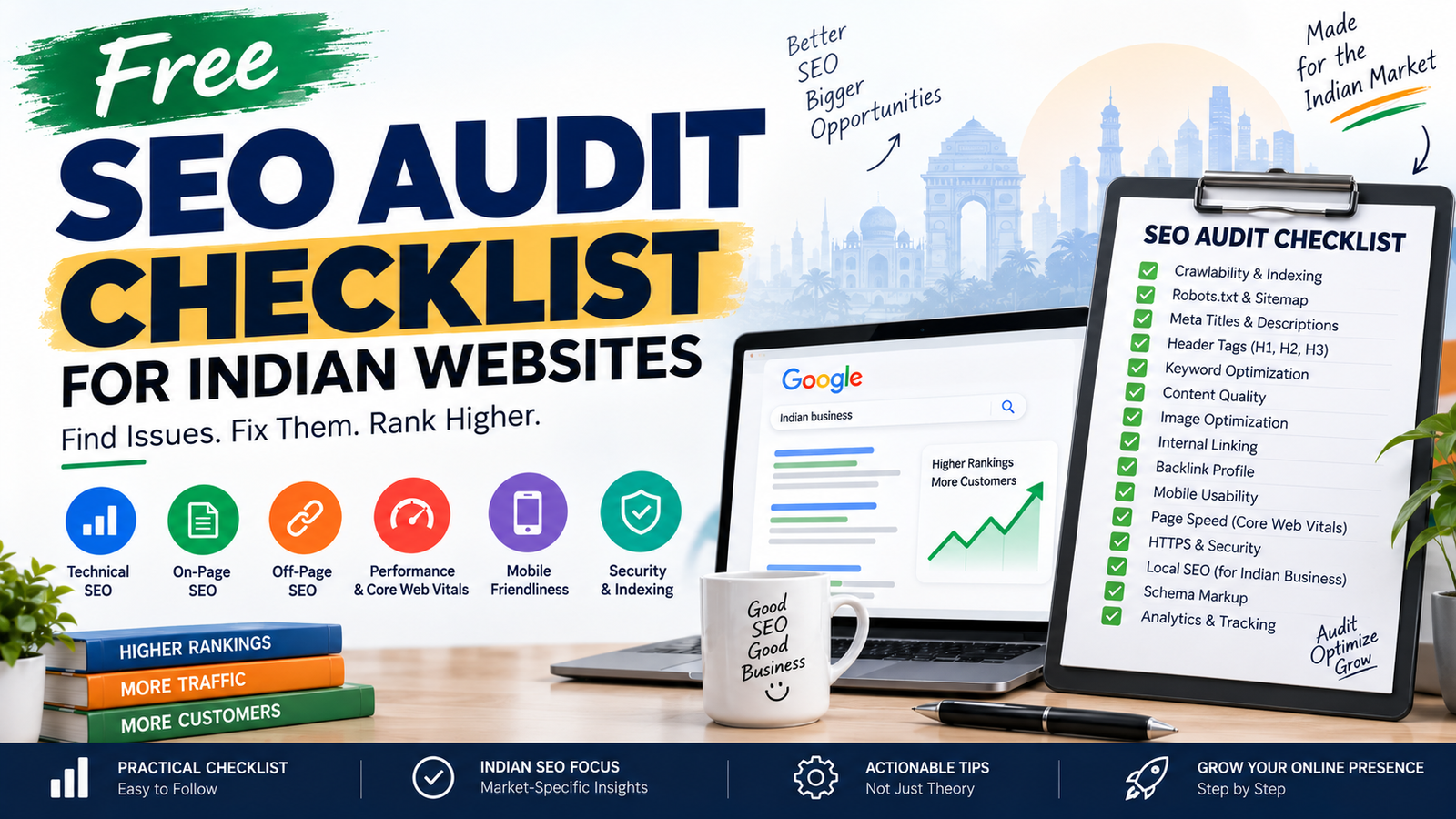
Most SEO audit you’ll be sold cost between ₹15,000 and ₹75,000 and arrive as a 40-page PDF you never read. About 80% of what’s in them is the same list of checks, run with the same free tools, that you could run yourself in an afternoon. So here’s the list. This is the seo audit checklist we work through on client sites at Namo Marketing, in a Google Sheet you can copy and use. 63 checks across crawling, technical health, on-page, content, local, links, tracking and AI search readiness. Every row tells you why the check matters and which tool to use. The score tab updates automatically as you fill it in, and it counts your outstanding Critical and High issues separately, because those two numbers are the actual output of an audit. It’s built for Indian businesses. That means the local section covers Google Business Profile and NAP consistency across JustDial, IndiaMART and Sulekha, and the technical section assumes your visitors are on mobile 4G rather than office fibre. Free, no email required to view — though if you give us one we’ll send you the updated version when Google changes something. Download the checklist What’s inside Four tabs: Start Here — how to use it, what the statuses mean, and a worked example row. Audit Checklist — the 63 checks, grouped into eight categories, each with a plain-English explanation of why it matters and the exact tool to check it with. Dropdown status field on every row. Score — updates itself as you work. Per-category percentages, an overall score, and separate counters for Critical and High issues still outstanding. N/A rows are excluded from scoring, so the number stays honest. Action Plan — a blank tracker for turning the failures into assigned, dated tasks. The eight categories: Category Checks Covers Crawl & Indexing 10 Whether Google can find and index your pages at all Technical 12 HTTPS, Core Web Vitals, mobile usability, redirects On-Page 9 Titles, descriptions, headings, URLs, alt text Content 8 Intent match, cannibalisation, thin pages, freshness Local SEO (India) 9 Google Business Profile, reviews, NAP consistency, Indian directories Links 7 Internal linking, broken links, backlink quality Tracking 5 GA4, Search Console, conversion and call tracking AI Search 3 Structured data and whether AI tools can parse your pages How to use it Make a copy into your own Drive, then work top to bottom. Set the status on every row — Pass, Fail, or N/A if it genuinely doesn’t apply. Leave it blank if you haven’t checked yet; the score only counts rows you’ve actually assessed. Budget about two hours for a small site. Most of it is quick. A handful of checks need a crawler, and Screaming Frog’s free tier handles up to 500 URLs, which covers most Indian SMB sites entirely. When you’re done, ignore the percentage and look at the two numbers at the bottom of the Score tab: Critical outstanding and High outstanding. Work the Critical list in order. Nothing else matters until that number is zero. Tools you’ll need (all free) An honest note on what a checklist can’t do A perfect score doesn’t mean you’ll rank. It means your fundamentals are clean and nothing is actively broken — which is the floor, not the ceiling. Rankings come from being the better answer, having content people cite, and earning authority over time. A checklist can’t tell you whether your page deserves to beat a competitor who’s been publishing for eight years. It can tell you whether you’re losing to them for a stupid, fixable reason, and that’s worth two hours of anyone’s afternoon. Also: don’t run this once. Re-run it quarterly. Sites decay — plugins break things, redirects pile up, someone ships a staging noindex to production. Most of the problems this catches were introduced by people who work at your company. If the Critical list is longer than you expected That’s common, and it’s usually a handful of root causes rather than 15 separate problems. Namo Marketing has run technical SEO for Indian businesses for over nine years. If you’d like someone to walk through your completed sheet and tell you what’s actually urgent, book a free 30-minute call or ring +91 9717 710 650. We’ll tell you which items you can safely ignore, which is usually more useful than a longer list.

SEO or PPC First for an Indian Startup with ₹50,000/Month?

SEO or PPC First for an Indian Startup

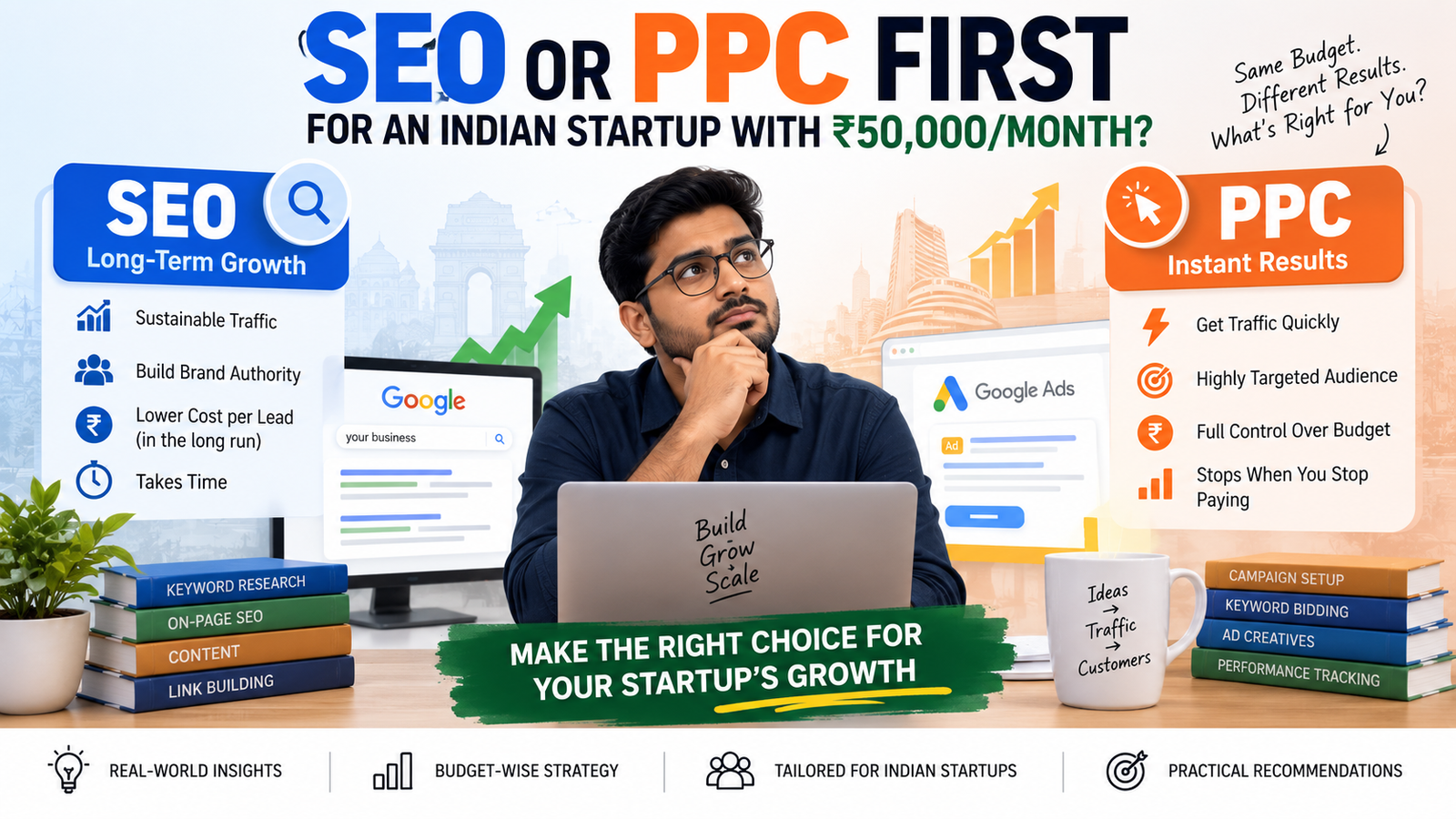
Every agency answers this question in the way that suits what they sell. SEO agencies say SEO, because retainers are recurring. PPC agencies say ads, because results arrive fast enough to keep the client happy. Both will tell you “it depends” and then recommend the thing they do. Here’s a more useful starting point: at ₹50,000 a month, the wrong answer isn’t SEO or PPC. It’s splitting it evenly. That budget is enough to do one channel properly and not enough to do two. Most startups that divide it end up with a PPC account below the threshold where Google’s bidding can learn anything, and an SEO programme producing one article a month, and they conclude after six months that digital marketing doesn’t work. This article gives you a decision framework, the actual arithmetic of what ₹50,000 buys in each channel, and an honest section on when neither is the right answer. Start with one question, not two Before comparing channels, answer this: does demand for what you sell already exist in the search box? Someone in Gurgaon typing “orthodontist near me” or “GST software for small business” is telling you the demand is there and the only question is who captures it. Both SEO and PPC compete for that person. PPC gets you in front of them tomorrow at a price. SEO gets you in front of them in six months for free, forever, until someone outranks you. But if you’ve built something people don’t yet search for — a new category, a novel product, a behaviour change — search captures almost nothing, because nobody is typing the query. Pouring ₹50,000 into either channel to fight over a hundred monthly searches is a way to spend a year learning that the demand wasn’t there. Open Google Keyword Planner and look up the terms a customer would use. If your main commercial keywords show meaningful monthly volume in India, keep reading. If they show 10–100 searches a month, your ₹50,000 belongs in demand creation — content, community, partnerships, founder-led social — not in either channel discussed here. What ₹50,000 actually buys In PPC. Assume ₹15,000 to management, whether that’s an agency fee or the salary share of someone in-house, leaving ₹35,000 in media. What that produces depends entirely on your cost per click, and this is where you should be sceptical of every benchmark article you read, including the numbers below. Published India CPC benchmarks disagree wildly. One widely cited 2026 source puts average Indian CPCs at ₹8–25 depending on industry. Another reports the range as ₹5 to over ₹600. A third puts health insurance alone at ₹250–460 per click. These aren’t small discrepancies — they differ by two orders of magnitude, because each was built on a different keyword set with undisclosed methodology. So don’t plan on any of them. Instead, run the calculation with your own number: ₹35,000 ÷ your CPC = clicks. Clicks × your landing page conversion rate = leads. Leads × your close rate = customers. ₹50,000 ÷ customers = your true CAC. Worked example at a ₹35 CPC and a 3% conversion rate: 1,000 clicks, 30 leads, and at a 20% close rate, 6 customers. Your customer acquisition cost is roughly ₹8,300. Now the only question that matters: is a customer worth more than ₹8,300 to you? If your average order value is ₹3,000 and they buy once, PPC will never work at that CPC and no amount of optimisation will fix it. If your customer is worth ₹80,000 over two years, you should be spending far more than ₹50,000. Run that calculation before you spend anything. It takes twenty minutes with Keyword Planner and it saves some startups an entire year. In SEO. ₹50,000 a month buys roughly four to six genuinely good articles, technical fixes, and a small amount of link acquisition. What it does not buy is revenue in month one, or month three. Realistically you’re looking at four to six months before meaningful traffic and often longer in competitive categories — top-ranking pages tend to be years old, and you are competing against that accumulated age. The trade is straightforward. PPC stops the day you stop paying. SEO compounds and keeps producing after you stop investing. The question is whether your runway survives the gap. The runway test This decides it for most startups, and it has nothing to do with which channel is “better.” Your situation Lead with Under 9 months runway, need revenue now PPC, heavily. You cannot afford a six-month blank period 12+ months runway, or already profitable SEO-led, with a small PPC budget for validation Pre-product-market-fit, still learning who buys PPC. You’re buying data faster than you’re buying customers, and that’s the correct purchase Local service business with a physical location Neither first — see the section below High CPC category, low order value SEO, because PPC arithmetic will never clear Long sales cycle, high ticket, B2B Both eventually, PPC first to learn which messages land The third row deserves emphasis. Early on, PPC’s real value isn’t the customers — it’s that within three weeks you know which keywords convert, which headline works, and what objection kills the sale. That intelligence then tells you what to write for SEO. Running SEO first means guessing at all of it for six months. Why splitting ₹50,000 evenly usually fails ₹25,000 in media spend is below the point where automated bidding has enough conversion data to optimise. Google’s smart bidding needs volume; starve it and it never exits the learning phase. Meanwhile ₹25,000 of SEO is one decent article a month plus a bit of technical work, which in a competitive Indian category is close to nothing. You end up sub-scale in both, see weak results in both, and can’t tell which one failed because of the channel and which failed because of the budget. Pick one. Run it properly for six months. Then reinvest what it earns into the second. The default plan I’d recommend For most … Read more

JustDial vs Google Business Profile: Where Indian Leads Actually Come From Now

JustDial vs Google Business Profile: Where Indian Leads Actually Come From Now

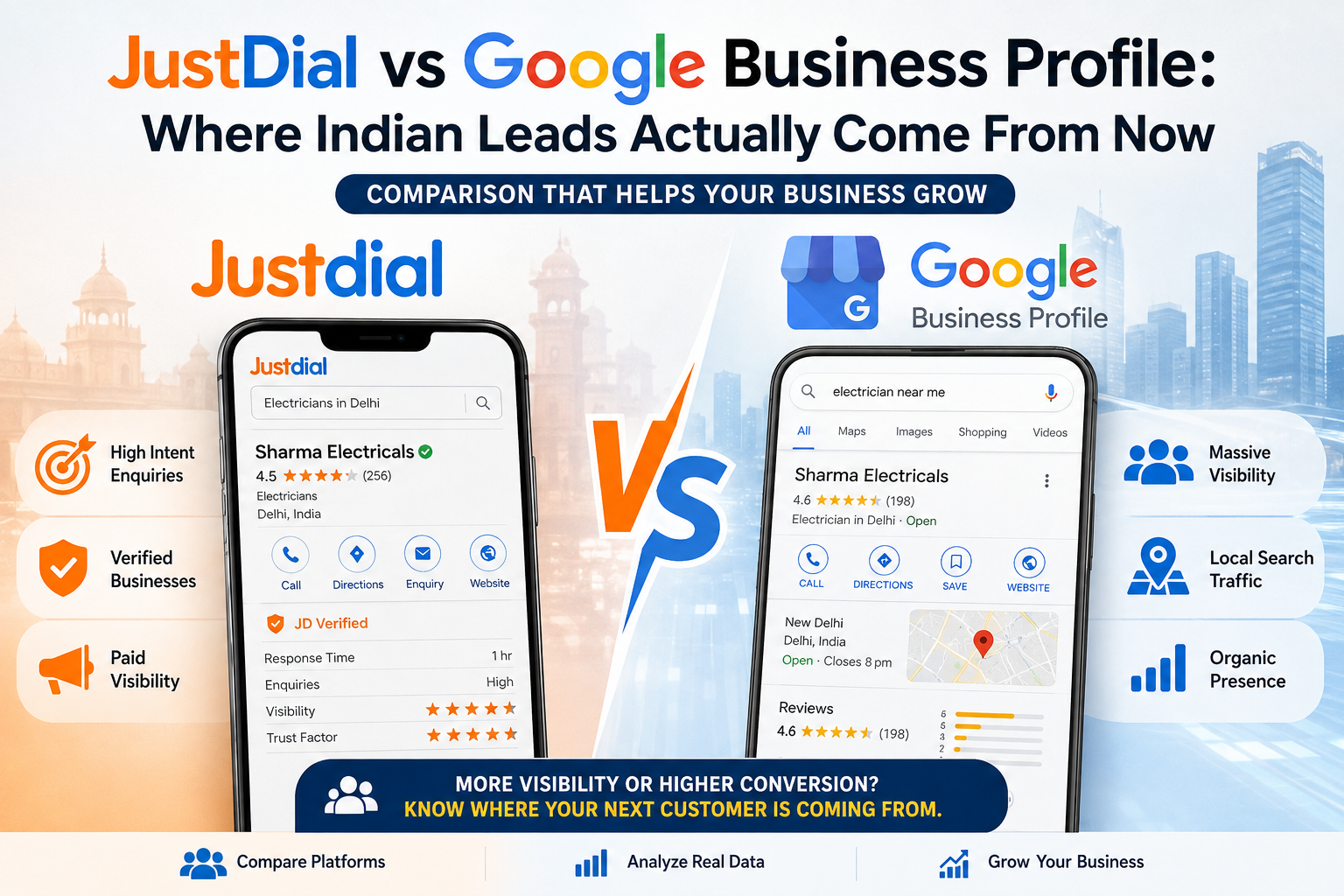
Every few weeks a JustDial executive calls a business owner in Delhi and offers a package. ₹36,000 a year. ₹84,000 for premium. Guaranteed visibility, guaranteed enquiries. The owner has heard the pitch before, maybe paid for it before, and has no real way to judge whether it’s worth it. Here’s a way to judge it. In the quarter ending March 2026, JustDial’s active listings grew 12.1% year on year to 54.7 million. Over the same period, its traffic fell 4.7% to 182.4 million unique visitors. Both figures come from the company’s own results filing. Read those two numbers together. More businesses are competing on the platform every quarter, and fewer people are visiting it. That’s not an opinion about JustDial’s quality. It’s arithmetic about your odds. This article compares JustDial and Google Business Profile honestly — including the cases where JustDial is still the better buy, because they exist and most agency blogs pretend they don’t. Then it gives you a way to measure which one actually works for your business rather than trusting either sales pitch, ours included. What JustDial’s own numbers say JustDial is listed, so it discloses operational metrics every quarter. That makes this the rare comparison you can run on audited figures rather than vendor claims. From the FY26 results: Metric (quarter ending 31 March 2026) Figure Change YoY Unique visitors 182.4 million −4.7% Active listings 54.7 million +12.1% Active paid campaigns 631,530 — Revenue from operations ₹307.2 crore +6.2% Operating EBITDA margin 28.9% — Three things worth pulling out. Traffic per listing is falling fast. Divide visitors by listings and the ratio dropped roughly 15% in a single year. Every quarter, the same audience is split across more businesses. If you renewed at the same price this year, you bought less. Traffic is also falling sequentially. It was 197.7 million in the September 2025 quarter and 182.4 million by March 2026. That’s a trend, not a seasonal dip. Only about 1.2% of listings are paid campaigns. 631,530 paying advertisers out of 54.7 million listings. Whatever the sales call implies, being listed is not the same as being found — the platform is built so that free listings mostly exist to make the paid tier necessary. One honest correction to something you may read elsewhere: JustDial’s net profit fell 36.5% in that quarter, and several articles have used that as proof the business is collapsing. It isn’t quite that. The profit drop was driven largely by lower treasury income as bond yields moved, not by the core operation, which still grew revenue 6.2% at a healthy margin. JustDial is a profitable company. The problem for you as an advertiser isn’t its profitability — it’s the traffic-per-listing ratio, which is a different thing entirely. What you’re actually buying, on each platform The financials matter less than the structural difference, which most comparisons skip. JustDial Google Business Profile Cost ₹30,000–₹1,00,000+ per year, negotiated Free What you own Nothing. Placement is rented and ends when you stop paying An asset tied to your business, with reviews and photos that persist How you rank Largely by package tier By relevance, distance and prominence — earned, not bought Lead exclusivity The same enquiry typically goes to several listed businesses at once The customer calls or messages you directly When you stop paying Visibility drops immediately Nothing changes; the profile stays Renewal pressure High — roughly 12,000 telesales and field staff across 250+ cities None Reach concentration About 70% of revenue from the top 11 cities Wherever your customers are The exclusivity line is the one that decides most cases. On JustDial’s core model, an enquiry is distributed to multiple advertisers in the category, and you compete on speed and price with three or four others who received the same lead. On Google, someone searching “AC repair near me” sees the map pack, taps your listing, and calls you. Not you and four competitors. You. That difference explains why lead-quality complaints are common in public reviews of JustDial’s paid packages, sitting alongside genuinely positive ones from long-term advertisers. Both sets of reviews are describing the same mechanism accurately. A shared-lead model works well when demand is urgent and abundant, and works badly when it isn’t. The search behaviour that changed underneath both platforms JustDial’s original product was a phone number. You called 88888-88888 and a human told you where to buy a washing machine. That was genuinely useful in 2005, when most Indians had no smartphone. Today, 85.7% of JustDial’s own traffic comes from mobile and only 2.8% from its voice platform. The behaviour it was built for has largely moved to a search box and a map. Meanwhile, the discovery moment has consolidated. When someone in Lajpat Nagar wants a dentist, the sequence is: unlock phone, type “dentist near me”, look at the three map results, check the star rating, tap call. Your Google Business Profile is the entire storefront in that moment — the rating, the photos, the hours, whether the phone number works. There’s now a third layer forming on top. When someone asks ChatGPT or Gemini for a recommendation, the assistant is pulling from structured, well-maintained public sources — Google’s local data prominently among them. A neglected profile isn’t just invisible in the map pack now; it’s invisible to the tools an increasing number of people ask first. That’s a reason to fix the free asset before renewing the paid one. Where JustDial still genuinely works This section exists because a comparison that concludes “the free thing is always better” isn’t a comparison, it’s marketing. JustDial still earns its fee in specific situations. Urgent, commoditised, phone-first services. AC repair, packers and movers, pest control, plumbing, appliance servicing. The customer wants three quotes in ten minutes and doesn’t care who you are. Shared leads suit that. If you can quote fast and close on the phone, volume compensates for exclusivity. Tier-2 and tier-3 cities with older buyers. JustDial’s voice platform is a small share of traffic overall, but … Read more

Gst on Google Ads and Meta Ads in India — Invoices, Input Tax Credit, and What to Hand Your Ca

Gst on Google Ads and Meta Ads in India — Invoices, Input Tax Credit, and What to Hand Your Ca

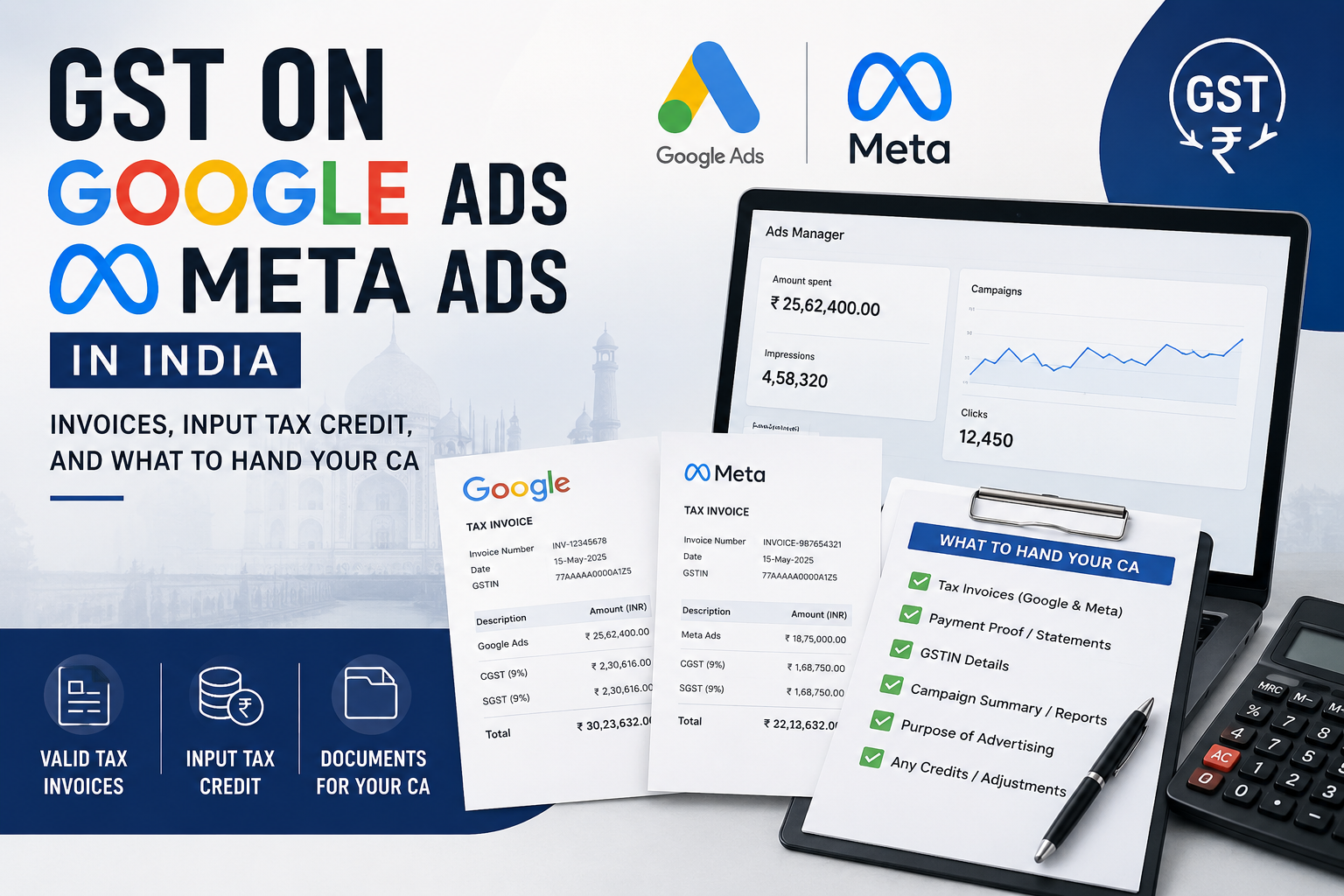
You spend ₹2,00,000 a month on Google Ads and Meta Ads. Somewhere in that number is ₹36,000 of GST. Whether you get it back, whether you owe it to the government at all, and whether you’re quietly building up a liability that surfaces during your next audit — all of it depends on one thing most business owners never look at. The name of the company at the top of your invoice. Get that wrong and three things go sideways at once: you miss input tax credit you were entitled to, you skip a reverse charge payment you didn’t know you owed, and your CA spends March reconstructing twelve months of ad spend from your bank statement. This guide walks through the whole thing in the order it actually matters, ending with a list of exactly what to put in a folder and send to your accountant. One note before we start: this is general information, not tax advice. Rules change with every Finance Act, and three of them changed recently. Confirm your specific position with your CA before you act on anything here. First, find out who actually billed you Both Google and Meta sell advertising in India through two completely different routes, and they attract completely different tax treatment. Route A — an Indian entity billed you. Your invoice carries an Indian GSTIN and PAN. For Google Ads this is usually Google India Private Limited; for Meta, it’s Facebook India Online Services Private Limited, which has been the seller for India-based ad accounts since October 2018. The invoice shows 18% GST as a separate line. This is a normal domestic purchase under forward charge — the platform collects the tax and pays it to the government. Route B — a foreign entity billed you. The supplier is Google Ireland Limited or Meta Platforms Ireland Limited. There’s no Indian GSTIN on the document and no GST line. This is an import of services, and the tax obligation moves to you. Two things people get wrong here. First, the currency is not the test — a foreign entity can still bill you in rupees. Look for the Indian GSTIN, not the ₹ symbol. Second, agencies running several client accounts routinely mix the two buckets in their books because a single business can have one account on each route. Tag every invoice at the time you book it, not in March. Add your GSTIN to the ad account (this is the ₹36,000 mistake) If you never gave the platform your GSTIN, it has classified you as a consumer, not a business. Your invoice won’t identify you as a registered recipient, and the input tax credit you were entitled to becomes very hard to defend. On Google Ads: Billing & Payments → Settings → your payments profile → the “India Tax” section. Enter your GSTIN there and it flows into all future invoices. On Meta: Ads Manager → Payment Settings → add your business name, address and GSTIN. Meta’s help centre is explicit that entering a GSTIN isn’t mandatory, but that you need it there if you want to take input tax credit. There’s a second trap, and Google flags it in its own documentation: the state in your GSTIN must match the state in the bill-to address on the invoice. If your GSTIN is Delhi and the billing address says Gurugram, the invoice is treated as issued to an unregistered person and reported that way in the platform’s GST returns. Your credit disappears and you won’t find out until reconciliation. Fix both of these today. It takes four minutes per platform and it is the single highest-return compliance task in this entire article. Route A: Claiming ITC when the invoice already has GST on it This is the straightforward case. Advertising services are taxed at 18%, and that rate survived the 2025 move to a simplified slab structure. Ad spend is a business input, and advertising isn’t on the blocked-credit list in Section 17(5), so the credit is available. The mechanics: The practical failure mode isn’t the law, it’s reconciliation. If the invoice doesn’t show up in your 2B, the credit isn’t safely claimable — chase the platform’s billing support rather than claiming and hoping. Route B: reverse charge, and why it generates notices Here’s the situation that quietly creates trouble. You download an invoice from Google Ireland or Meta Ireland, it shows the full amount you spent with no GST anywhere on it, and you book the whole figure as an advertising expense. Done, you think. It isn’t. Under the IGST Act, a service supplied from outside India to a recipient in India is an inter-state supply, and the tax is payable by the recipient under the reverse charge mechanism. Online advertising falls squarely within this as an OIDAR service. You self-assess 18% IGST, pay it, and then claim it back. What that looks like in practice, on a ₹5,00,000 foreign invoice: On a net basis this is close to cash-flow neutral. You pay it and you get it back, usually in the same period. Which is exactly why so many businesses skip it — the circularity makes it feel pointless. It isn’t pointless: the law exists so a foreign platform can’t supply into India untaxed while an Indian agency has to charge 18%. And skipping it doesn’t leave you square. It leaves you with an undisclosed liability that shows up in a GST audit along with interest under Section 50. The registration trap: if you have RCM liability, you generally must register for GST even if your turnover is below the ₹20 lakh threshold. A small business running foreign-billed ads can be required to register purely because of its ad spend. The 6% equalisation levy is gone — stop deducting it This is where most articles you’ll find on this topic are out of date, so it’s worth being blunt. The 6% Equalisation Levy on online advertising — the “Google tax,” introduced in 2016 — no longer applies … Read more