
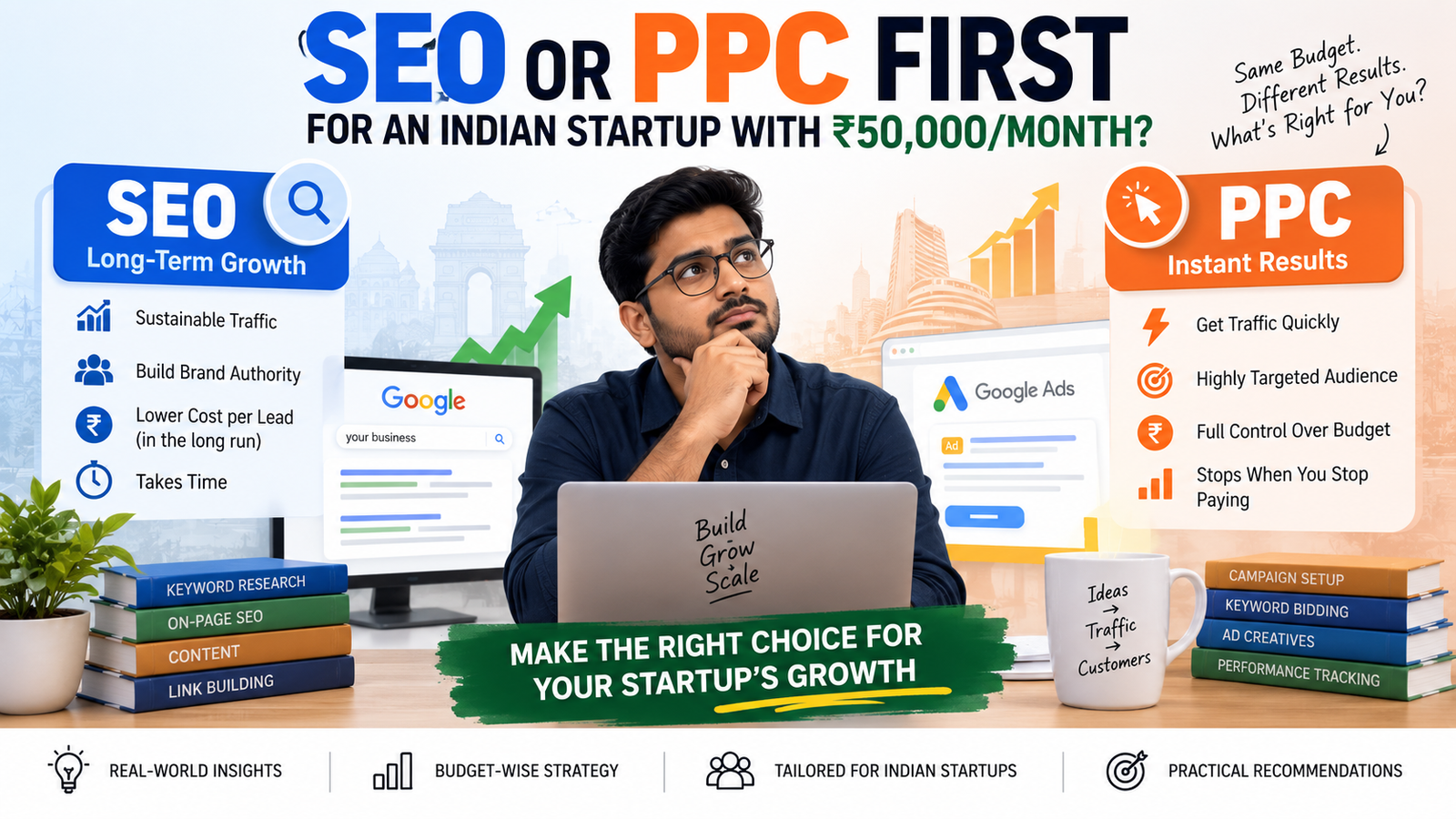
Every agency answers this question in the way that suits what they sell. SEO agencies say SEO, because retainers are recurring. PPC agencies say ads, because results arrive fast enough to keep the client happy. Both will tell you “it depends” and then recommend the thing they do.
Here’s a more useful starting point: at ₹50,000 a month, the wrong answer isn’t SEO or PPC. It’s splitting it evenly. That budget is enough to do one channel properly and not enough to do two. Most startups that divide it end up with a PPC account below the threshold where Google’s bidding can learn anything, and an SEO programme producing one article a month, and they conclude after six months that digital marketing doesn’t work.
This article gives you a decision framework, the actual arithmetic of what ₹50,000 buys in each channel, and an honest section on when neither is the right answer.
Start with one question, not two
Before comparing channels, answer this: does demand for what you sell already exist in the search box?
Someone in Gurgaon typing “orthodontist near me” or “GST software for small business” is telling you the demand is there and the only question is who captures it. Both SEO and PPC compete for that person. PPC gets you in front of them tomorrow at a price. SEO gets you in front of them in six months for free, forever, until someone outranks you.
But if you’ve built something people don’t yet search for — a new category, a novel product, a behaviour change — search captures almost nothing, because nobody is typing the query. Pouring ₹50,000 into either channel to fight over a hundred monthly searches is a way to spend a year learning that the demand wasn’t there.
Open Google Keyword Planner and look up the terms a customer would use. If your main commercial keywords show meaningful monthly volume in India, keep reading. If they show 10–100 searches a month, your ₹50,000 belongs in demand creation — content, community, partnerships, founder-led social — not in either channel discussed here.
What ₹50,000 actually buys
In PPC. Assume ₹15,000 to management, whether that’s an agency fee or the salary share of someone in-house, leaving ₹35,000 in media. What that produces depends entirely on your cost per click, and this is where you should be sceptical of every benchmark article you read, including the numbers below.
Published India CPC benchmarks disagree wildly. One widely cited 2026 source puts average Indian CPCs at ₹8–25 depending on industry. Another reports the range as ₹5 to over ₹600. A third puts health insurance alone at ₹250–460 per click. These aren’t small discrepancies — they differ by two orders of magnitude, because each was built on a different keyword set with undisclosed methodology.
So don’t plan on any of them. Instead, run the calculation with your own number:
₹35,000 ÷ your CPC = clicks. Clicks × your landing page conversion rate = leads. Leads × your close rate = customers. ₹50,000 ÷ customers = your true CAC.
Worked example at a ₹35 CPC and a 3% conversion rate: 1,000 clicks, 30 leads, and at a 20% close rate, 6 customers. Your customer acquisition cost is roughly ₹8,300.
Now the only question that matters: is a customer worth more than ₹8,300 to you? If your average order value is ₹3,000 and they buy once, PPC will never work at that CPC and no amount of optimisation will fix it. If your customer is worth ₹80,000 over two years, you should be spending far more than ₹50,000.
Run that calculation before you spend anything. It takes twenty minutes with Keyword Planner and it saves some startups an entire year.
In SEO. ₹50,000 a month buys roughly four to six genuinely good articles, technical fixes, and a small amount of link acquisition. What it does not buy is revenue in month one, or month three. Realistically you’re looking at four to six months before meaningful traffic and often longer in competitive categories — top-ranking pages tend to be years old, and you are competing against that accumulated age.
The trade is straightforward. PPC stops the day you stop paying. SEO compounds and keeps producing after you stop investing. The question is whether your runway survives the gap.
The runway test
This decides it for most startups, and it has nothing to do with which channel is “better.”
| Your situation | Lead with |
|---|---|
| Under 9 months runway, need revenue now | PPC, heavily. You cannot afford a six-month blank period |
| 12+ months runway, or already profitable | SEO-led, with a small PPC budget for validation |
| Pre-product-market-fit, still learning who buys | PPC. You’re buying data faster than you’re buying customers, and that’s the correct purchase |
| Local service business with a physical location | Neither first — see the section below |
| High CPC category, low order value | SEO, because PPC arithmetic will never clear |
| Long sales cycle, high ticket, B2B | Both eventually, PPC first to learn which messages land |
The third row deserves emphasis. Early on, PPC’s real value isn’t the customers — it’s that within three weeks you know which keywords convert, which headline works, and what objection kills the sale. That intelligence then tells you what to write for SEO. Running SEO first means guessing at all of it for six months.
Why splitting ₹50,000 evenly usually fails
₹25,000 in media spend is below the point where automated bidding has enough conversion data to optimise. Google’s smart bidding needs volume; starve it and it never exits the learning phase. Meanwhile ₹25,000 of SEO is one decent article a month plus a bit of technical work, which in a competitive Indian category is close to nothing.
You end up sub-scale in both, see weak results in both, and can’t tell which one failed because of the channel and which failed because of the budget.
Pick one. Run it properly for six months. Then reinvest what it earns into the second.
The default plan I’d recommend
For most Indian startups at this budget with existing search demand, PPC-led with SEO groundwork:
Months 1–3. ₹40,000 to Google Ads — tightly targeted, one campaign, high-intent keywords only, no broad match, no Display, no Performance Max until you have conversion data. ₹10,000 to foundations: site speed, one strong landing page, conversion tracking that actually works, and your Google Business Profile if you’re location-based. Set up call tracking on day one. If you can’t attribute a lead to a keyword, you’re not running PPC, you’re donating.
Months 4–6. Read the data. Which keywords produced customers, not clicks? Cut everything else. If CAC clears your unit economics, hold the split. If it doesn’t after honest optimisation, shift 60% to SEO and accept the longer timeline.
Months 7–12. If PPC is profitable, start funding SEO out of the profit rather than the original ₹50,000, targeting the exact keywords you already know convert. This is the compounding move — you’re no longer guessing what to rank for, you’ve bought that answer.
The things that beat both at this budget
An honest agency should tell you when the answer is neither, so here it is.
If you’re a local business, your Google Business Profile is free, takes an afternoon, and outperforms ₹50,000 of anything else in the first ninety days. Reviews, photos, complete category data. Do this before you spend a rupee. We wrote a fuller comparison of local channels in our piece on JustDial versus Google Business Profile.
If your landing page converts at under 1%, fixing the page is worth more than any traffic you buy. Doubling conversion halves your CAC across every channel simultaneously. Spending on traffic before fixing the page means paying twice for the same lesson.
If you have existing customers, referrals and email cost close to nothing and convert several times better than cold traffic. Startups routinely spend ₹50,000 chasing strangers while never emailing the two hundred people who already bought.
If you have no conversion tracking, install it before anything else. Without it, six months from now you’ll have spent ₹3,00,000 and have opinions instead of data.
Five ways this budget gets wasted
- Running ads to the homepage. Every campaign needs a page built for that specific search intent.
- Broad match with automated bidding on a small budget. You’ll spend ₹35,000 on searches only loosely related to what you sell.
- Judging SEO at month three. It hasn’t had time to work. Judging it at month eight is fair.
- Buying links. In competitive Indian categories the cheap-link market is a trap, and cleaning up after a penalty costs more than the links did.
- Changing strategy monthly. Neither channel produces signal in four weeks. Commit to a six-month test or don’t start.
Frequently asked questions
Is ₹50,000 a month enough for Google Ads in India?
For most categories, yes — if it’s concentrated. ₹35,000 in media on a narrow set of high-intent keywords in one city can produce meaningful volume. Spread across many keywords, multiple cities and several campaign types, the same amount produces nothing usable.
How long does SEO take to show results in India?
Typically four to six months for early movement and longer in competitive categories. Pages that rank at the top tend to have years of accumulated authority, which is what you’re working against. Anyone promising first-page rankings in thirty days is either targeting keywords nobody searches or misrepresenting what will happen.
Should a startup do SEO and PPC together?
Eventually, yes — they reinforce each other, and PPC data tells you exactly what SEO should target. At ₹50,000 a month you generally can’t fund both at working scale. Lead with one, and add the second from the returns of the first.
Which is cheaper, SEO or PPC?
Over three months PPC is cheaper because SEO has produced nothing yet. Over three years SEO is dramatically cheaper because the traffic continues without ongoing media spend. Your runway decides which timeframe you’re allowed to optimise for.
What if my industry has very high CPCs?
Run the CAC calculation honestly. If a customer is worth less than what it costs to acquire one at your CPC, PPC is not a channel you can use profitably, and SEO plus organic distribution is the realistic path. That’s a legitimate answer, not a failure.
The short version
Existing search demand plus short runway means PPC first. Existing demand plus longer runway means SEO-led. No existing demand means neither — go create it. And in every case, run the CAC calculation before spending, because it frequently answers the question on its own.
Namo Marketing has run both channels for Indian businesses for over nine years, and we’ll tell you when your budget is better spent elsewhere. If you want an honest read on which channel fits your unit economics, book a free strategy session or call +91 9717 710 650. We can also help with SEO or Google and Meta campaigns once you know which one you need.