
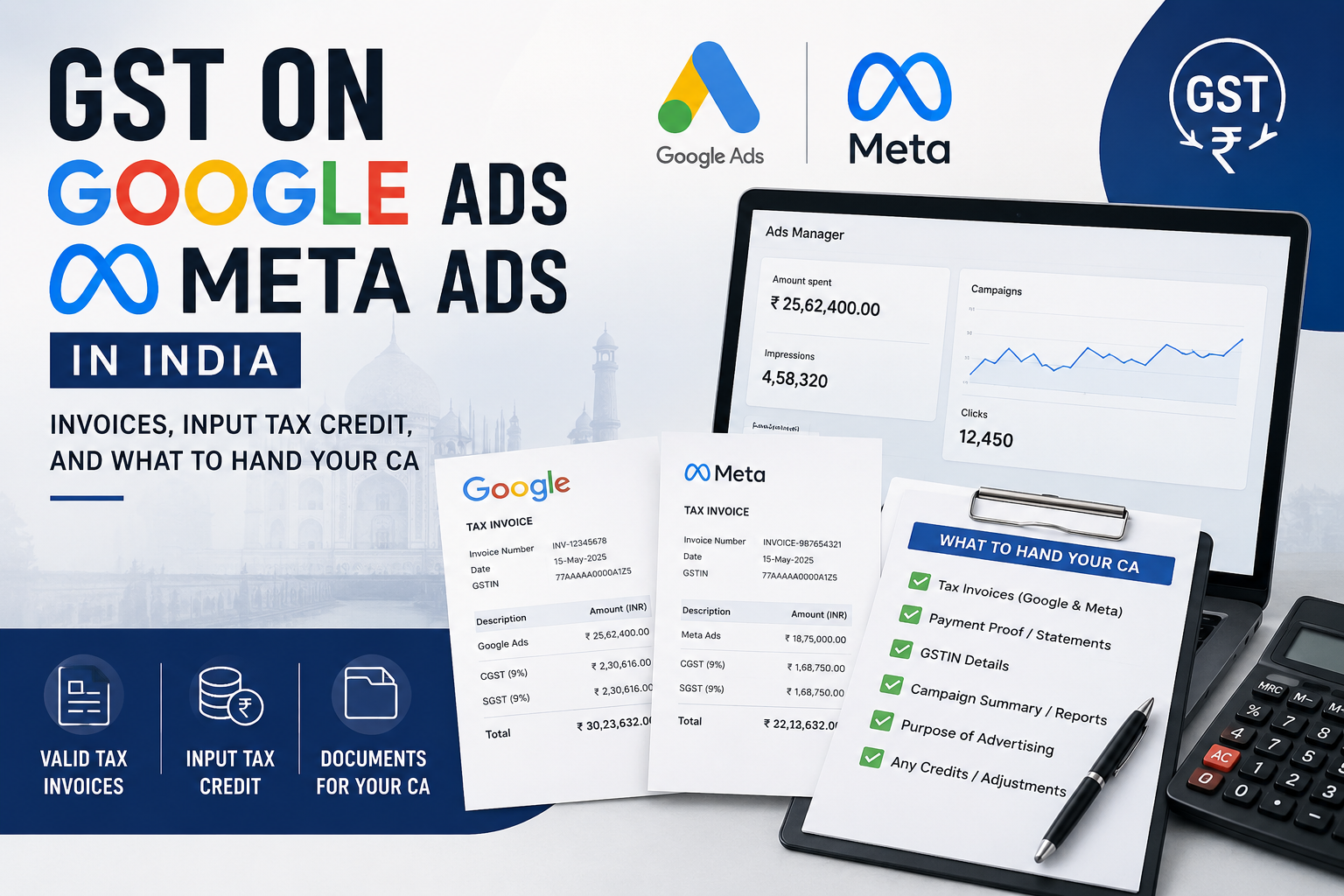
You spend ₹2,00,000 a month on Google Ads and Meta Ads. Somewhere in that number is ₹36,000 of GST. Whether you get it back, whether you owe it to the government at all, and whether you’re quietly building up a liability that surfaces during your next audit — all of it depends on one thing most business owners never look at.
The name of the company at the top of your invoice.
Get that wrong and three things go sideways at once: you miss input tax credit you were entitled to, you skip a reverse charge payment you didn’t know you owed, and your CA spends March reconstructing twelve months of ad spend from your bank statement. This guide walks through the whole thing in the order it actually matters, ending with a list of exactly what to put in a folder and send to your accountant.
One note before we start: this is general information, not tax advice. Rules change with every Finance Act, and three of them changed recently. Confirm your specific position with your CA before you act on anything here.
First, find out who actually billed you
Both Google and Meta sell advertising in India through two completely different routes, and they attract completely different tax treatment.
Route A — an Indian entity billed you. Your invoice carries an Indian GSTIN and PAN. For Google Ads this is usually Google India Private Limited; for Meta, it’s Facebook India Online Services Private Limited, which has been the seller for India-based ad accounts since October 2018. The invoice shows 18% GST as a separate line. This is a normal domestic purchase under forward charge — the platform collects the tax and pays it to the government.
Route B — a foreign entity billed you. The supplier is Google Ireland Limited or Meta Platforms Ireland Limited. There’s no Indian GSTIN on the document and no GST line. This is an import of services, and the tax obligation moves to you.
Two things people get wrong here. First, the currency is not the test — a foreign entity can still bill you in rupees. Look for the Indian GSTIN, not the ₹ symbol. Second, agencies running several client accounts routinely mix the two buckets in their books because a single business can have one account on each route. Tag every invoice at the time you book it, not in March.
Add your GSTIN to the ad account (this is the ₹36,000 mistake)
If you never gave the platform your GSTIN, it has classified you as a consumer, not a business. Your invoice won’t identify you as a registered recipient, and the input tax credit you were entitled to becomes very hard to defend.
On Google Ads: Billing & Payments → Settings → your payments profile → the “India Tax” section. Enter your GSTIN there and it flows into all future invoices.
On Meta: Ads Manager → Payment Settings → add your business name, address and GSTIN. Meta’s help centre is explicit that entering a GSTIN isn’t mandatory, but that you need it there if you want to take input tax credit.
There’s a second trap, and Google flags it in its own documentation: the state in your GSTIN must match the state in the bill-to address on the invoice. If your GSTIN is Delhi and the billing address says Gurugram, the invoice is treated as issued to an unregistered person and reported that way in the platform’s GST returns. Your credit disappears and you won’t find out until reconciliation.
Fix both of these today. It takes four minutes per platform and it is the single highest-return compliance task in this entire article.
Route A: Claiming ITC when the invoice already has GST on it
This is the straightforward case. Advertising services are taxed at 18%, and that rate survived the 2025 move to a simplified slab structure. Ad spend is a business input, and advertising isn’t on the blocked-credit list in Section 17(5), so the credit is available.
The mechanics:
- The platform’s invoice appears in your GSTR-2B for the relevant period.
- You claim it in GSTR-3B, Table 4(A)(5) — all other ITC.
- Section 16 conditions apply as usual: you hold a valid tax invoice, the service has been received, the supplier has actually reported and paid the tax, and you’ve paid the supplier within 180 days.
The practical failure mode isn’t the law, it’s reconciliation. If the invoice doesn’t show up in your 2B, the credit isn’t safely claimable — chase the platform’s billing support rather than claiming and hoping.
Route B: reverse charge, and why it generates notices
Here’s the situation that quietly creates trouble. You download an invoice from Google Ireland or Meta Ireland, it shows the full amount you spent with no GST anywhere on it, and you book the whole figure as an advertising expense. Done, you think.
It isn’t. Under the IGST Act, a service supplied from outside India to a recipient in India is an inter-state supply, and the tax is payable by the recipient under the reverse charge mechanism. Online advertising falls squarely within this as an OIDAR service. You self-assess 18% IGST, pay it, and then claim it back.
What that looks like in practice, on a ₹5,00,000 foreign invoice:
- Raise a self-invoice in your records for ₹5,00,000.
- Compute IGST at 18% = ₹90,000, converting foreign currency at the rate applicable on the relevant date.
- Pay that ₹90,000 in cash — RCM liability cannot be set off against your existing credit balance. Report it in GSTR-3B, Table 3.1(d).
- Claim the same ₹90,000 as ITC in Table 4(A)(3) — inward supplies liable to reverse charge.
On a net basis this is close to cash-flow neutral. You pay it and you get it back, usually in the same period. Which is exactly why so many businesses skip it — the circularity makes it feel pointless. It isn’t pointless: the law exists so a foreign platform can’t supply into India untaxed while an Indian agency has to charge 18%. And skipping it doesn’t leave you square. It leaves you with an undisclosed liability that shows up in a GST audit along with interest under Section 50.
The registration trap: if you have RCM liability, you generally must register for GST even if your turnover is below the ₹20 lakh threshold. A small business running foreign-billed ads can be required to register purely because of its ad spend.
The 6% equalisation levy is gone — stop deducting it
This is where most articles you’ll find on this topic are out of date, so it’s worth being blunt.
The 6% Equalisation Levy on online advertising — the “Google tax,” introduced in 2016 — no longer applies to consideration arising on or after 1 April 2025. It was removed by the Finance Act 2025. The separate 2% levy on e-commerce supplies had already gone on 1 August 2024. Neither exists today.
If your accounting process still grosses up foreign ad invoices by 6%, or your CA is still filing Form 1 for equalisation levy, that stopped being necessary from FY 2025-26 onwards.
Two clarifications, because this causes confusion:
- The equalisation levy going away does not remove your GST reverse charge obligation. They are different taxes under different laws. RCM on imported ad services is very much alive.
- The equalisation levy was never creditable — it was pure cost. GST under RCM is creditable. So this is a genuine reduction in the cost of foreign-billed advertising, not a shuffle.
TDS: the separate obligation people confuse with GST
GST and TDS are unrelated. One is indirect tax you charge or self-assess; the other is income tax you withhold on behalf of the recipient. Both can apply to the same invoice.
Advertising is explicitly included in the statutory definition of “work,” so payments to an Indian ad platform fall under the contractor provision — Section 194C under the Income-tax Act, 1961, now mirrored as Section 393 of the Income-tax Act, 2025 for payments from 1 April 2026 onward. Rates and thresholds carried over unchanged:
| Rate — company, firm, LLP | 2% |
| Rate — individual or HUF payee | 1% |
| No PAN furnished | 20% |
| Threshold | ₹30,000 single payment or ₹1,00,000 aggregate to that payee in the year |
Three practical points:
Don’t deduct TDS on the GST component. Deduct only on the taxable value where GST is shown separately, per CBDT Circular 23/2017. Deducting on the gross figure is one of the most common errors in ad-spend accounting.
You pay the platform in full and claim the TDS back. Google and Meta don’t accept a net payment. You remit the full invoice amount, deposit the TDS separately, then send the platform your TDS certificate — Google’s billing help centre gives the entity’s PAN and the address to use, and asks for certificates each quarter, due by 15 August, 15 November, 15 February and 15 June. Once verified, the amount is credited back to your ad account. Miss the deadline and you’ve simply donated 2% of your annual ad budget.
Form names changed too. For FY 2026-27, non-salary TDS is reported in Form 140 (previously Form 26Q) and the certificate is Form 131 (previously Form 16A). If your accounting software still says 26Q, check whether it’s been updated.
Failing to deduct at all is the expensive outcome: 30% of the expense can be disallowed under the corresponding provision to Section 40(a)(ia), plus interest at 1% per month.
When your agency runs the ads
If a PPC agency manages your campaigns, the treatment depends on whose ad account it is and who is named on the platform invoice.
Model 1 — your account, agency manages it. The platform bills you directly. You claim the ITC on ad spend and handle any RCM yourself. The agency separately invoices you for its management fee with 18% GST, which you also claim. Clean, transparent, and the model we use at Namo Marketing.
Model 2 — agency’s account, agency rebills you. The platform bills the agency. The agency then either recovers the cost as a pure agent under Rule 33 of the CGST Rules — which requires a written authorisation, separate disclosure on the invoice, and recovery at actual cost — or treats the spend as its own input and bills you a single inclusive amount with GST on the whole thing.
The distinction matters because in Model 2 you have no direct invoice from Google or Meta, and if the pure-agent conditions aren’t properly met, the tax outcome shifts. Before you sign with any agency, ask one question: whose name is on the platform invoice? If they can’t answer it clearly, that tells you something.
The folder to hand your CA
This is the section to bookmark. Every month, for each ad account:
- Platform invoice PDFs — Google and Meta, every ad account, downloaded monthly rather than reconstructed in March
- Entity tagged on each invoice — domestic or foreign, marked at the time of booking
- Bank and card statements matching each payment
- Self-invoices for every foreign-entity invoice, with the exchange rate used and the date it was taken
- GSTR-2B reconciliation showing the platform invoices actually appeared
- TDS challans and copies of the certificates you issued to the platform, with proof of submission
- Agency invoices kept separate from pass-through ad spend, so management fee and media spend never merge into one line
- Screenshots of your GSTIN as entered in each platform’s billing settings, with the state matching your bill-to address
An hour a month on this list is worth more than a week of reconstruction at year end.
Six mistakes we see most often
- GSTIN never added to the ad account, so every invoice is B2C
- GSTIN state doesn’t match the bill-to state, quietly voiding the credit
- Foreign-entity invoices booked as plain expense with no RCM computed
- TDS deducted on the GST-inclusive amount instead of the taxable value
- Equalisation levy still being grossed up or filed, more than a year after it was abolished
- Agency fee and media spend booked as a single figure, making both ITC and TDS impossible to compute correctly
Frequently asked questions
Is GST applicable on Google Ads in India?
Yes, at 18%. If Google’s Indian entity bills you, the GST is on the invoice and you claim it as normal input tax credit. If a foreign Google entity bills you, no GST appears on the invoice and you must self-assess 18% IGST under reverse charge.
Can I claim input tax credit on Facebook and Instagram ads?
Yes, provided you’re GST-registered, the ads are for business purposes, your GSTIN is on the invoice, and the invoice reflects in your GSTR-2B. Advertising is not blocked credit under Section 17(5).
Do I still need to pay the 6% equalisation levy on Google Ads?
No. It ceased to apply to consideration arising on or after 1 April 2025. Your GST reverse charge obligation on foreign-billed ads is unaffected and still applies.
Should I deduct TDS on Google Ads payments?
If you’re a specified person under the contractor TDS provisions, yes — 2% on the taxable value for a company payee, subject to the ₹30,000 / ₹1,00,000 thresholds. Pay the platform in full, deposit the TDS separately, and send the certificate to reclaim the amount.
Do I need GST registration if my turnover is below ₹20 lakh but I run foreign-billed ads?
Generally yes. A reverse charge liability typically triggers compulsory registration regardless of the turnover threshold. Confirm your position with your CA.
Getting the ad spend right is only half the job
None of the above makes your campaigns perform better. It just stops you paying more tax than you owe on the money you’re already spending.
Namo Marketing has run performance campaigns for Indian businesses for over nine years, and we bill transparently — your ad account, your invoices, your input tax credit, our management fee shown separately. If you’d like a second opinion on how your ad spend is being structured, or you want Google and Meta campaigns managed properly from the ground up, book a free strategy session or call us on +91 9717 710 650.
This article is general information for Indian businesses, current as of the date of publication. It is not tax or legal advice. GST rates, TDS provisions and section numbering change with each Finance Act. Please confirm your specific position with a qualified chartered accountant before acting.
1 thought on “Gst on Google Ads and Meta Ads in India — Invoices, Input Tax Credit, and What to Hand Your Ca”