Three weeks ago, the economics of this question changed.
On 27 August 2026, OpenAI began showing managed ads to ChatGPT Free and Go users in India, with over 50 brands in the first wave. On 4 September, self-serve access to ChatGPT Ads Manager opened to any Indian business, with reported daily budgets starting around ₹725.
So there’s now a paid door into ChatGPT. This article is about the other one — appearing inside the answer itself, unpaid, because the system decided you were worth mentioning. That door is still open, it’s still free, and most Indian businesses aren’t near it.
Before the tactics, one finding that should reorganise how you think about this.
Brand mentions beat backlinks, roughly three to one
Ahrefs’ analysis of AI Overviews found that branded web mentions correlate with AI citation probability at 0.664, against 0.218 for backlinks. Whether a page earns links turns out to matter much less than whether your brand name appears across the web at all — in articles, forums, directories, videos, comparison posts, anywhere.
If that holds, a decade of SEO instinct is pointed the wrong way for this particular surface. You’re not trying to accumulate link equity. You’re trying to become a name the system has seen often enough, in enough places, to say out loud.
A caveat I’d rather state than bury: almost every number in this article comes from a vendor study, and they are correlations, not proven causation. The methodologies are rarely disclosed in full, and some widely circulated AI-search stats don’t survive a close look. Treat all of it as directional. The reason I’m still reporting it is that the directional signal is consistent across independent studies, which is the most you can currently ask of this field.
The three systems work differently
Lumping these together as “AI search” is the most common mistake, and it leads to wasted effort.
Google AI Overviews runs on Google’s own search index. SeoClarity’s analysis of 432,000 keywords found 97% of AI Overviews cite at least one source from the top 20 organic results. Position matters heavily within that: a page ranking first has roughly a 58% chance of being cited, falling to about 14% by position ten. Traditional SEO is not dead here. It’s the entry requirement.
ChatGPT works on two layers. There’s the training data, static and huge. Then there’s live retrieval, powered by Bing, which activates mostly for commercial-intent queries — anything with “best”, “reviews”, “comparison”, or a year in it. One study found commercial prompts trigger a web search about 53.5% of the time, against 18.7% for informational ones. Wikipedia dominates its source mix at roughly 47.9% of top-10 source share.
The citation gap between platforms is enormous. One 2026 study of 34,234 AI responses found ChatGPT named brands in just 0.59% of answers, while Perplexity did so 13.05% of the time and Grok around 27% — a 46-fold spread. ChatGPT is the hardest to get named in and the one with the most users. That’s the difficulty of the task, stated plainly.
What actually moves the needle
Ordered by strength of evidence, not by ease.
1. Rank in the top 20 for the query. With 97% of AI Overviews pulling from the top 20 organic, everything else is optional until this is true. If you’re on page four, AI optimisation is a distraction from the actual problem. Our SEO audit checklist covers the fundamentals that get you into range.
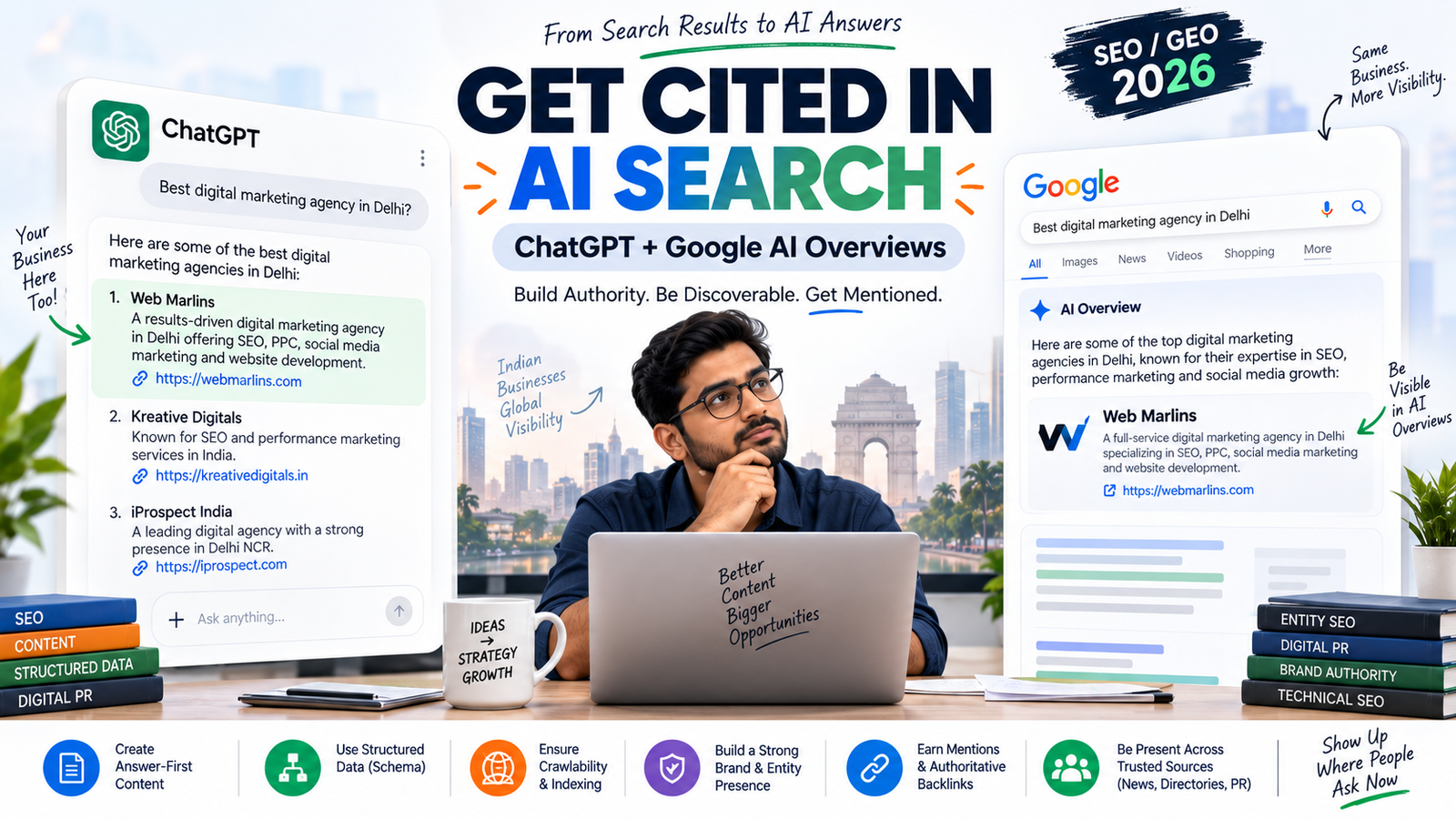
2. Get mentioned in places that aren’t your website. This is the 0.664 finding in practice. Industry publications, local news, podcast appearances, comparison articles, supplier and partner sites, genuine directory listings. One article in a respected publication is worth more than ten on sites nobody reads. For Indian businesses this is unusually winnable, because most of your competitors are doing zero earned media.
3. Show up on YouTube. YouTube accounts for roughly 19–21% of AI Overview source share, and Ahrefs’ study of 75,000 brands found brand mentions in YouTube titles and transcripts were the single strongest correlating factor with AI Overview visibility. Part of the reason is structural: Google owns both, and LLM training corpora include enormous volumes of YouTube transcripts. A five-minute video answering the same question as your best blog post gives you two chances at citation on one query.
4. Be present where people discuss your category. Reddit is about 18.5% of AI Overview citations, with Facebook, Instagram and Quora also material. This means participating honestly in communities, not spamming them — astroturfing is detectable and reputationally expensive.
5. Make your entity unambiguous. AI systems cross-reference sources before naming a business. Contradictions get you dropped. Your name, address, phone number, founding year and service list should match exactly across your site, Google Business Profile, JustDial, IndiaMART, Sulekha and LinkedIn. Add a substantial About page with founder, founding year, headquarters and services stated as plain facts. If your business qualifies for a Wikidata entry, that clears an entity-trust bar the system otherwise has to guess at.
6. Keep content fresh. AI-cited content averages about 1,064 days old against 1,432 for Google’s organic top ten — roughly 25.7% fresher. ChatGPT shows the strongest freshness preference of the platforms tested. Updating existing pages usually beats publishing new ones.
7. Make sure the crawlers can actually reach you. Cyrus Shepard’s May 2026 meta-analysis of 54 studies put URL accessibility at the top of the evidence-ranked factors, above search rank. Check that you aren’t blocking GPTBot, OAI-SearchBot, PerplexityBot or Google-Extended in robots.txt unless you’ve deliberately chosen to. A lot of sites block them by accident via a security plugin’s default settings.
8. Write answers that stand alone. A paragraph that answers one specific question completely, without requiring the surrounding article for context, is the unit these systems extract. Clear structured data helps — Organization, LocalBusiness, Service, FAQPage, Article.
The India-specific bit
Bing matters more than you think. ChatGPT’s retrieval layer runs on Bing. Almost every Indian business ignores Bing entirely — no Bing Places listing, no Bing Webmaster Tools. That’s a genuine gap you can close in an hour, and very few of your competitors have.
Your Google Business Profile is doing double duty. It already drives map pack visibility, and it’s now a primary entity source for AI systems answering “best dentist in Dwarka” style questions. If you haven’t claimed and completed it, that’s the first move — we covered the broader local picture in our comparison of JustDial and Google Business Profile.
Review text matters, not just star ratings. “Good service” tells an AI nothing. “The physiotherapist explained my back pain and I recovered in three weeks” tells it what you treat, how you communicate, and what outcome to expect. When you ask for reviews, ask customers to mention what they came in for.
Describe yourself specifically. “Dental clinic in Thane” is weak. “Family dental clinic in Thane specialising in braces, root canals and children’s dentistry” gives the system something to match a query against. Do this on your site, your GBP description, and every directory.
Things to be sceptical about
llms.txt. A proposed standard for telling AI systems how to read your site. No major platform has confirmed using it. It costs ten minutes if you want to hedge, but anyone selling it as a ranking factor is ahead of the evidence.
Word count claims. You’ll see confident assertions that 2,500–4,000 word pages get cited at 57–63% versus 3–4% for short pages. Treat that with caution — it’s the kind of finding that usually reflects longer pages being better pages, not length causing citations. Write what the question needs.
“Guaranteed AI citation” services. Nobody can guarantee this. There is no submission form, no index to pay into, and the systems change monthly.
The whole field’s evidence base. These studies are produced by companies selling AI-visibility tools. That doesn’t make them wrong, but it does mean you should weight your own testing above anyone’s published percentages.
How to measure it
Search Console won’t show you AI citations, so you need other methods.
Test prompts manually. Write 20 questions a customer would actually ask — “best digital marketing agency in Delhi”, “how much does SEO cost in India” — and run them monthly across ChatGPT, Gemini, AI Overviews and Perplexity. Record whether you’re mentioned, cited, or absent. Unglamorous, but it’s real data about your actual queries rather than someone’s aggregate.
Check your server logs for GPTBot, OAI-SearchBot, PerplexityBot and ClaudeBot. If they’ve never visited, nothing downstream can work.
Watch for referral traffic from chatgpt.com and perplexity.ai in GA4. Volumes are small but the visitors tend to be high-intent.
A 30-day starting plan
Week 1. Confirm AI crawlers aren’t blocked in robots.txt. Claim Bing Places and Bing Webmaster Tools. Audit NAP consistency across your site, GBP and the Indian directories, and fix every mismatch.
Week 2. Rewrite your About page with concrete facts. Add Organization and LocalBusiness schema. Rewrite your GBP description to be specific about services and location.
Week 3. Pick your five most important customer questions. For each, make sure one page answers it completely in a self-contained way. Update rather than create where you can.
Week 4. Set your 20 test prompts and record the baseline. Record one short video answering your most common customer question and put it on YouTube with your business name in the title and description.
Then do the slow work: earn mentions. That’s the part that compounds and the part nobody can shortcut for you.
Frequently asked questions
Can ChatGPT recommend my local business?
Yes. For commercial and local queries ChatGPT retrieves live web results, so businesses with consistent profiles, real reviews and third-party mentions can be recommended by name. It names brands far less often than Perplexity or Grok — one study found 0.59% of answers versus 13.05% — so treat it as the hardest surface to win.
Do I need to do anything different from normal SEO?
Mostly no, with one important shift. Ranking in the top 20 remains the entry requirement, since 97% of AI Overviews cite a source from there. The shift is that off-site brand mentions correlate with AI citations about three times more strongly than backlinks do, which argues for spending more on PR, video and community presence than on link building.
How long does it take to get cited in AI search?
Typically three to six months, depending on your existing authority and how competitive your category is. There’s no submission process and no way to accelerate it with money — other than buying ads, which is a separate thing.
Does blocking AI crawlers protect my content?
It prevents your content being used, and it also guarantees you’re never cited. That’s a legitimate trade for some publishers. For a business that wants customers, it isn’t.
Is llms.txt worth adding?
There’s no confirmed evidence any major platform uses it. It takes ten minutes if you want to hedge, but don’t let anyone charge you for it.
The short version
Rank in the top 20, get your name mentioned in places you don’t own, keep your business facts identical everywhere, stay fresh, and don’t block the crawlers. The tactics are new; the underlying requirement — be a real business that other people talk about — is old.
Namo Marketing has worked on search visibility for Indian businesses for over nine years, and we’re testing this surface on our own site and our clients’ rather than selling certainty about it. If you want a look at where your business currently stands across AI search, book a free strategy session or call +91 9717 710 650. Our SEO services now include AI visibility baselining as standard.
Figures cited are from third-party studies published in 2026 by Ahrefs, SeoClarity, Growth Memo, Profound and others, and reflect correlations rather than confirmed ranking factors. Current as of September 2026; this field changes quickly.