
You asked for your logins. The reply was vague, or there was no reply. Now you are wondering whether a company you paid for two years can actually stop you using your own website.
Short answer: often yes, in practice. Control is physical, not moral. Whoever holds the registrar login holds the domain, regardless of who paid.
If your agency won’t give website access, work in this order: settle any outstanding invoice, send one specific written request naming each asset and a deadline, then escalate to the registrar or hosting provider directly with proof of payment. Most refusals are leverage over money and resolve at step one. If they do not, recovering a domain is harder than recovering hosting or files, so prioritise the domain.
This article walks the ladder from easiest to hardest, and tells you honestly where each rung tends to lead.
First, find out what you actually control
Before escalating, establish your position. Fifteen minutes with the ownership audit will tell you whether this is an inconvenience or a serious problem.
The short version: run a WHOIS lookup on your domain, try logging into your hosting panel, and check whether your name appears anywhere as registrant or account holder.
| What you find | Your position |
|---|---|
| Domain registrant is your company | Strong, you can move everything |
| Domain in agency name, hosting in yours | Mixed, the domain is the fight |
| Both in agency’s name, invoices in yours | Weak but arguable |
| Nothing in your name, paid in cash | Very weak |
That last row is worth naming plainly. If you paid informally, hold no account in your name and have no written contract, you have very little leverage. Rebuilding is likely to be faster than recovering.
Step 1: Settle the money
Most access refusals are not ideological. They are an unpaid invoice wearing a different outfit.
If you owe anything, even something you dispute, consider paying it and recovering your assets first. You can argue about the invoice afterwards from a position where you control your website. Arguing first, while they control it, usually costs more.
If you genuinely owe nothing, say so in writing with the payment records attached, and move to step 2.
Step 2: Send one specific written request
Vague requests are easy to deflect. Specific ones create a record.
Your email should name each asset individually, state the exact change you want, give an email address to send credentials to, and set a reasonable date. Something like:
We are requesting transfer of the following to our control by 25 October: the domain registration for example.com, administrator access to the hosting account, a full backup of website files and database, and owner access to the Google Business Profile. Please confirm by reply.
Keep it unemotional. This email may end up being read by a registrar’s support team, a payment processor, or a court. Write it for that reader.
Send it from a company email address, not WhatsApp. You want a timestamped written trail.
Step 3: Go to the provider directly
If there is no response, stop talking to the agency and start talking to the companies that actually hold the assets.
Hosting. If the account is in your business name or paid from your account, most hosting providers will help you recover it with proof of identity and payment. This is often the easiest win, because hosting companies deal with this routinely.
Domain registrar. Harder. Registrars are bound by registration records, and the registrant on file has the stronger claim. You will need evidence that the domain was registered on your behalf — invoices, emails, payment records.
Google accounts. Google has a process for claiming a Business Profile from an unresponsive manager, and ownership disputes for other products are handled through their support channels. Outcomes vary and timelines are not quick.
What proof helps: invoices in your company name, bank statements showing payment, email correspondence where the agency refers to it as your website, and the original engagement contract.
Step 4: Formal escalation
If the provider route fails, you are into formal territory. Talk to a lawyer before taking any of these steps. What follows is general information, not legal advice, and we are a marketing agency rather than a law firm.
A legal notice. A letter from an advocate costs relatively little and resolves a meaningful share of these disputes, because it signals you are willing to spend money on the problem. Many agencies comply at this stage.
Consumer forum. India’s consumer dispute redressal system can hear service-deficiency complaints, and the process is designed to be accessible without heavy legal costs. Whether your situation qualifies, and which forum applies, depends on the amounts and the facts.
Domain dispute processes. Formal domain dispute mechanisms exist, but they are built mainly for trademark conflicts, such as someone registering a name confusingly similar to your brand, rather than for contractual disputes with a developer who registered your own name on your behalf. They may not fit your situation.
Police complaint. Generally a poor fit. This is usually a civil contractual matter, and treating it as a criminal one tends to slow things down rather than speed them up, unless there is actual fraud.
Step 5: Know when to stop and rebuild
This is the part other articles leave out, and it is often the right answer.
Fighting for an asset has a cost in money, time and attention. Rebuilding also has a cost. Compare them honestly.
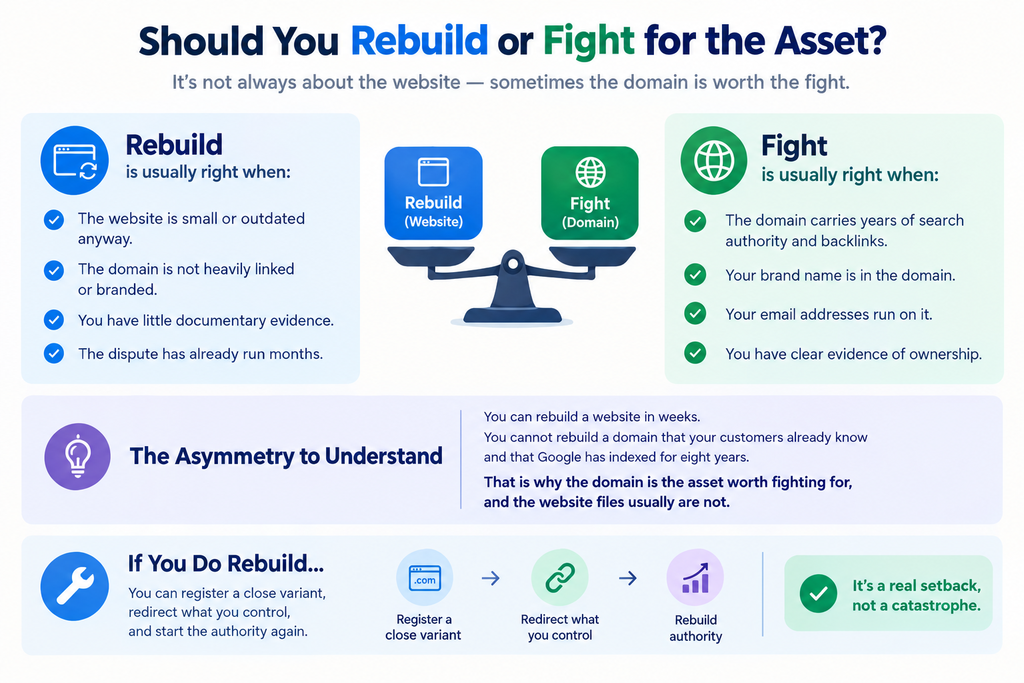
Rebuilding is usually right when: the website is small or outdated anyway, the domain is not heavily linked or branded, you have little documentary evidence, or the dispute has already run months.
Fighting is usually right when: the domain carries years of search authority and backlinks, your brand name is in the domain, your email addresses run on it, or you have clear evidence of ownership.
The asymmetry to understand: you can rebuild a website in weeks. You cannot rebuild a domain that your customers already know and that Google has indexed for eight years. That is why the domain is the asset worth fighting for, and the website files usually are not.
If you do rebuild, you can register a close variant, redirect what you control, and start the authority again. It is a real setback, not a catastrophe.
What to do differently next time
Whatever the outcome, four things prevent a repeat.
- Register your domain yourself, in your company’s name, with your email as registrant contact. Give the agency access, never ownership.
- Keep every account billed to you. Hosting, ads, tools.
- Put asset ownership in writing in the contract — domain, hosting, accounts, code, content, listed individually.
- Take a backup quarterly and keep it somewhere the agency cannot reach.
Frequently asked questions
Is it legal for an agency to withhold my website?
It depends on your contract and what they actually control. An agency that owns the domain registration has practical control whatever your view of the fairness. Where there is an unpaid invoice, they may have a contractual basis. Ask a lawyer about your specific agreement rather than assuming either way.
Can I force a domain transfer?
Not directly, and not quickly. Registrars act on the registration record, so the registrant on file has the stronger position. You can make a claim with evidence that the domain was registered on your behalf, but it is a process with an uncertain outcome rather than a button you can press.
What if my developer has disappeared entirely?
Go straight to the providers. Hosting companies and registrars have processes for unresponsive account holders, and you will need proof of payment and identity. Act quickly, because an abandoned domain can lapse and be bought by someone else.
Should I just pay what they are asking?
Often yes, if the amount is smaller than the cost of the fight. Recovering control and then disputing the invoice is usually cheaper than disputing the invoice while locked out. This is a commercial judgement, not a moral one.
How long does recovery take?
Hosting recovery can take days. Domain disputes take weeks to months. Formal legal routes take longer. If your website being offline is costing you revenue daily, factor that into whether to fight or rebuild.
Can I report an agency for this?
You can leave honest public reviews, which carries real weight for an agency that depends on reputation. Consumer forums exist for service deficiency complaints. Keep anything you publish factual and verifiable.
The order that works
Settle the money, send one specific written request, go to the providers, escalate formally, and know when rebuilding beats fighting. When an agency won’t give website access, the fastest resolution is almost always commercial rather than legal.
If you are in the middle of this and want a straight assessment of whether to fight or rebuild, talk to Namo Marketing. We will tell you which it is, including when the answer means you do not need us.
This article is general information for Indian businesses, not legal advice. Namo Marketing is a digital marketing agency. Consult a qualified lawyer about your specific situation.