

A business owner in Noida discovered his domain was registered in his web developer’s name four years after launch. He found out when the developer stopped answering calls and the renewal lapsed. The site, the email addresses and eight years of search rankings went dark.
He had paid every invoice. He had simply never checked.
To find out who owns your website domain, run a WHOIS lookup on your domain name and check the registrant organisation and registrant email. If the name or email belongs to your developer or agency rather than your company, they control the domain, regardless of who paid for it. The same question applies separately to your hosting, website files, ad accounts and analytics.
Most readers who run this audit find everything in order. The point is to know, rather than to assume, before the relationship with your agency ends.
The seven things to check
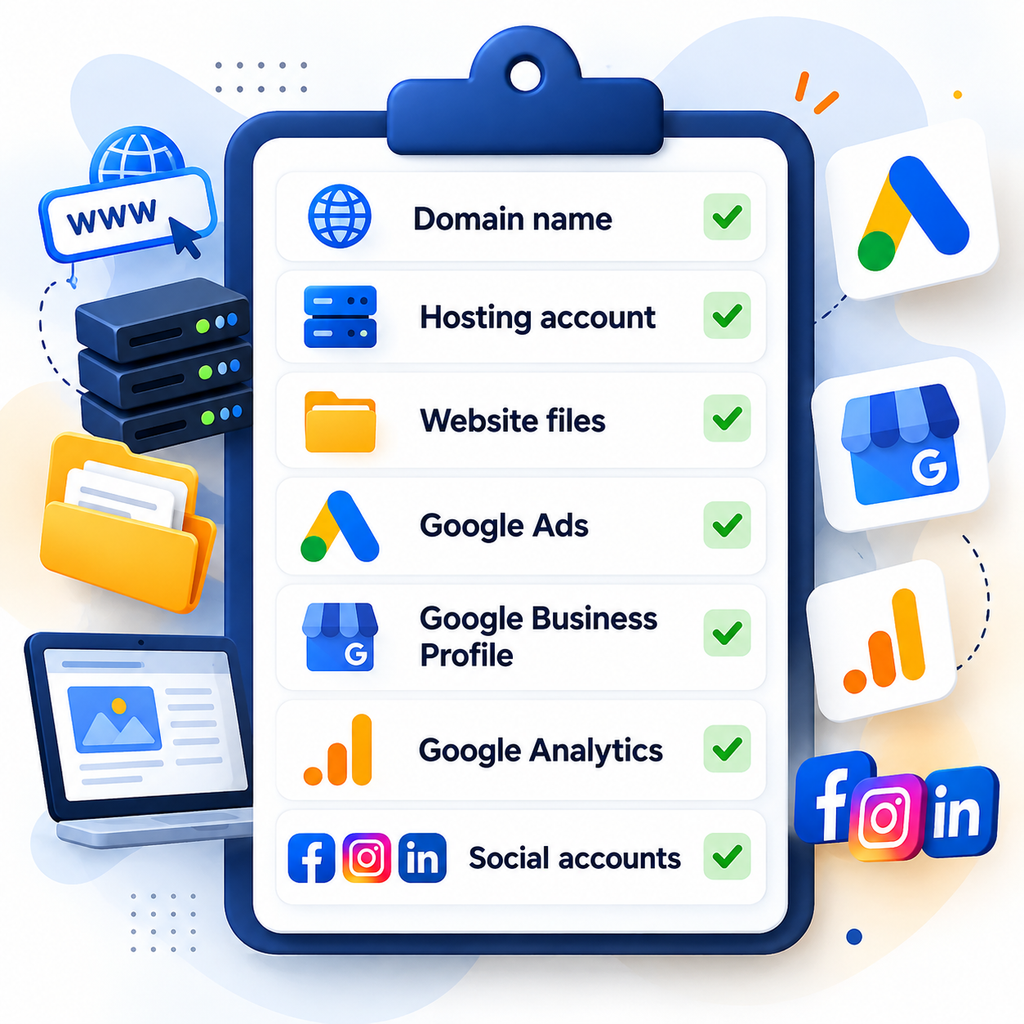
Ownership is not one question. It is seven, and you can hold some while losing others.
| Asset | Where to check | Bad answer looks like |
|---|---|---|
| Domain name | WHOIS lookup | Developer’s name or email as registrant |
| Hosting account | Login to hosting panel | You have no login at all |
| Website files | Hosting file manager or repository | No access, no backup |
| Google Ads | Billing settings in the account | Agency’s payments profile |
| Google Business Profile | Profile manager, owner role | You are a Manager, not Owner |
| Google Analytics | Admin, account access | Agency property, not yours |
| Social accounts | Business Manager settings | Agency’s Business Manager owns the Page |
Work down the list. Each takes two or three minutes.
Checking your domain
This is the one that matters most, because losing the domain loses everything attached to it: the website, the email addresses, the search history.
Run a WHOIS lookup. Any registrar offers one free, and ICANN runs a public lookup service. Type in your domain and read three fields:
- Registrant organisation. Should be your company name.
- Registrant email. Should be an address you control. An agency address here means they receive renewal and transfer notices, not you.
- Registrar. The company the domain is registered through, such as GoDaddy, BigRock, Hostinger, Namecheap and so on. You will need this if you move the domain later.
If privacy protection is enabled, the registrant details will show the privacy service instead of a name. That is not a problem in itself, but it means you cannot verify ownership from the outside. Log in to the registrar account directly. If you cannot log in, you have your answer.
A note on .in domains. India’s country-code domains are administered under NIXI, and registrar transfer processes for .in can differ from .com. If your domain is a .in, check your registrar’s specific transfer policy rather than assuming the generic process applies.
Checking hosting and website files
Ask yourself a simple question: if your agency disappeared tomorrow, could you log in to your hosting account?
If the answer is no, you do not control your website, whatever the contract says. Hosting panel access is the practical form ownership takes.
Two things to confirm. First, that an account exists in your company’s name with billing you control. Second, that you can download a full backup — files and database — without anyone’s help. If you have never done this, do it once now and keep the file.
The common Indian pattern: a developer runs twenty client sites on one reseller hosting account. No individual client has a login because no individual account exists. This is not necessarily malicious, since it is cheaper and simpler for them, but it means your site lives inside something you do not control.
Checking your advertising and analytics
Google Ads ownership follows the payments profile, not the work. Open Billing, then Settings, and look at whose company name and GSTIN appear. If it is the agency’s, Google’s billing relationship is with them.
Read Also: How to Transfer a Google Ads Account From Your Agency
Google Business Profile has two levels that people confuse. Being a Manager lets you edit. Being the Owner lets you decide who else gets access. Agencies often take Owner and give the client Manager. Check under the profile’s access settings. If you are not Owner, you can be removed.
Google Analytics should sit in an account belonging to your organisation. If your property lives inside the agency’s Analytics account, your historical data goes with them.
For social, the question is which Business Manager holds the Page. A Page inside an agency’s Business Manager can be removed from your reach. Ask to be added as a Business Manager admin on your own Page, or to have the Page moved to a Business Manager you own.
Who owns the website content and design?
This is the question where Indian practice and the law diverge most, and where you should talk to a lawyer rather than trust a blog.
In general terms, copyright in work created by an independent contractor does not automatically pass to the client simply because the client paid. Assignment usually needs to be in writing. Many Indian web development agreements say nothing about it at all.
The practical remedy is simpler than the legal one: get a written assignment of the website design, code and content into your next contract, or into an amendment to the current one. Most agencies will sign it without argument. The ones who refuse have told you something useful.
What to do if the audit goes badly
Found something in the wrong name? Do this in order.
- Do not accuse anyone yet. Most of these situations are administrative laziness rather than a hostage strategy, and they resolve in a week when asked politely.
- Ask in writing, specifically. Name the asset, the account, and what change you want — “please transfer the domain registration to our company account” is actionable; “please give us ownership” is not.
- Set a date. A reasonable deadline, in the same email.
- Start with the domain. It is the asset whose loss is irreversible. Everything else can be rebuilt.
- Pay anything outstanding. Most refusals trace back to an unpaid invoice. Settling it removes their argument.
How to never have this problem again
For any new agency or developer, four rules.
Register the domain yourself. Take twenty minutes and an email address. Then give the agency access rather than ownership. This single step prevents the worst outcome.
Keep billing in your name. Hosting, ads, tools. If you are paying, pay directly.
Get access, not reports. An agency that sends you a PDF dashboard instead of account access is managing your perception of the data rather than giving you the data.
Put asset ownership in the contract. One clause listing who owns the domain, hosting, accounts, code and content. Any agency that objects to writing down what you already believe to be true is worth a second look.
Frequently asked questions
How do I find out who owns my domain?
Run a WHOIS lookup on your domain through any registrar or ICANN’s public lookup. Check the registrant organisation and registrant email. If those show your developer or agency rather than your company, they control the domain even though you paid for it.
Does my web developer own my website?
They may own parts of it. The domain belongs to whoever is listed as registrant. Hosting belongs to whoever holds the account. Copyright in the design and code often stays with the creator unless assigned in writing. Check each separately rather than assuming one answer covers all three.
Can my agency hold my website hostage?
If they control the domain, hosting or server access, they have practical leverage, usually exercised over unpaid invoices. Whether they are entitled to depends on your contract. The faster resolution is almost always settling the invoice and asking again in writing.
What happens to my website if I stop paying my agency?
It depends entirely on what you control. If the domain and hosting are in your name, nothing happens except that updates stop. If they are in the agency’s name, the site can go offline when they stop paying for it. This audit tells you which situation you are in.
Who owns the content I paid a writer or agency to produce?
Payment alone does not always transfer copyright under Indian law, and written assignment is usually needed. Ask a lawyer about your specific agreement, and add an assignment clause to future contracts.
Should I register my own domain or let the agency do it?
Register it yourself. It takes twenty minutes, costs a few hundred rupees a year, and removes the single biggest risk in this entire list. Give the agency administrative access to manage it.
Fifteen minutes, once
Run the seven checks. Most businesses find everything is fine and stop worrying. The ones who find a problem find it while they still have a working relationship with the person who can fix it, which is far easier than discovering it during an argument.
If you would rather have someone go through it with you, Namo Marketing will run the audit and tell you plainly what you control. We register domains in our clients’ names and keep billing in their accounts, so our own clients can walk away from us whenever they want. That is the point.
1 thought on “Who actually owns your website, domain and ad accounts?”